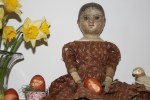
The Izannahs and I would like to share a few photos with you from our Easter celebration yesterday. We hope that you spent the day in the company of your nearest and dearest and that it was a glorious day for all.
Click on photos to enlarge.


Paula Walton’s doll-making notes

This category is for pictures of and information about antique dolls made by Izannah Walker.
The Izannahs and I would like to share a few photos with you from our Easter celebration yesterday. We hope that you spent the day in the company of your nearest and dearest and that it was a glorious day for all.
Click on photos to enlarge.
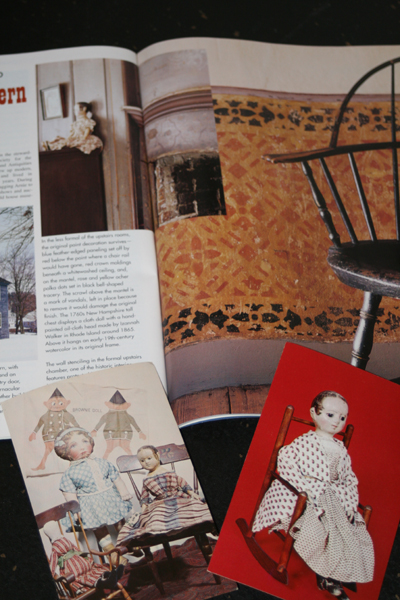 This is a resource list of photographs in magazines, books and on post cards. The entries listed here are for photographs only, with just an accompanying caption. Actual magazine articles and books that also have photographs are going to be listed under a separate heading. I plan to make this an ongoing list that I will add to as I run across photographs in my huge stash of Izannah resources (I’ve been saving Izannah information for years and years, not necessarily in an organized manner).
Early American Life Magazine, December 2001, page30.
Wenham Historical Association and Museum, Inc., Wenham, MA 01984, postcard.
Mary Merritt’s Doll Museum, Douglassville, PA, postcard.
Better Homes and Gardens Holiday Decorating, 1999, page 45. This is a wonderful photograph that shows an Izannah Walker doll plus eight other painted cloth dolls, two papier-mache dolls and a whole Christmas tree full of wooden peg dolls (penny wooden).
 Today I am starting the first step in drafting patterns for my Izannah doll making class. Just like in any other type of pattern making, I have to first take accurate measurements before I can actually draw out the pattern. This means I need to start by undressing the doll.
Since I plan to measure both dolls and compare, then average their measurements, I’ll have to do everything twice. Being just like a child, and wanting to play with my new toy first, I’m starting with Izannah II. I really haven’t had the opportunity to actually sit down and spend a lot of time with her since she arrived here. Don’t think she’s been neglected; I’ve stared lovingly at her every time I pass by where she sits, so she doesn’t feel slighted.
Izannah II has only two garments, a chemise and a dress.After carefully removing both pieces of clothing from the doll, I decided to wash them prior to measuring.
These are the steps I use to launder antique textiles:
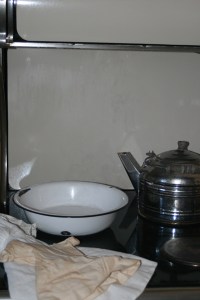 If the item I’m washing is not too large, i.e. a piece of doll clothing, I usually wash it in an enamelware bowl. A plastic, glass, or other non-reactive bowl would also be fine to use. I place a small spoonful of Orvus in the bottom of the bowl, and then add several spoonfuls of sodium perborate, if I’m using bleach. Next I pour in the heated distilled water. The warmth of the water will dissolve the Orvus and make the sodium perborate start to work. If I want my wash water temperature to be a bit cooler, I add room temperature distilled water to the bowl, then stir and add the item I’m washing.
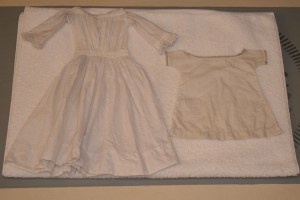 Work day one is at an end, but I’ve gotten side tracked, and all I’ve managed to get done is the laundry! That has a very familiar ring to it. At least this laundry is a lot more fun than the run of the mill dirty t-shirts and jeans.
I generally buy my Orvus and sodium perborate from Mini-Magic. A friend of mine recently found sodium perborate for sale on eBay at a good price, so you might want to check there too. She also located some at The Chemistry Store.
 Izannah Walker Journal