Today I am starting the first step in drafting patterns for my Izannah doll making class. Just like in any other type of pattern making, I have to first take accurate measurements before I can actually draw out the pattern. This means I need to start by undressing the doll.
Since I plan to measure both dolls and compare, then average their measurements, I’ll have to do everything twice. Being just like a child, and wanting to play with my new toy first, I’m starting with Izannah II. I really haven’t had the opportunity to actually sit down and spend a lot of time with her since she arrived here. Don’t think she’s been neglected; I’ve stared lovingly at her every time I pass by where she sits, so she doesn’t feel slighted.
Izannah II has only two garments, a chemise and a dress.After carefully removing both pieces of clothing from the doll, I decided to wash them prior to measuring.
These are the steps I use to launder antique textiles:
- First, and most importantly, I carefully look over the item I want to wash to make sure that I think it is sturdy enough to survive cleaning.I make sure that it isn’t colored with dyes that will run and bleed when wet and that the fabric itself retains its integrity and is not disintegrating.As a general rule, don’t wash antique silks and examine wools to make sure they have been washed previously before you wash them.Cottons and linens usually wash well.
- I wash all antique fabrics with distilled water and Orvus, which is a museum-quality washing paste. If I am washing white or light-colored cottons or linens that are stained or discolored, I bleach them using sodium perborate.Sodium perborate is heat-activated, so it’s necessary to heat the distilled water before using. Never use sodium perborate on wool or silk!.
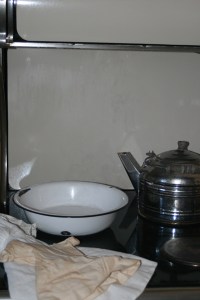 If the item I’m washing is not too large, i.e. a piece of doll clothing, I usually wash it in an enamelware bowl. A plastic, glass, or other non-reactive bowl would also be fine to use. I place a small spoonful of Orvus in the bottom of the bowl, and then add several spoonfuls of sodium perborate, if I’m using bleach. Next I pour in the heated distilled water. The warmth of the water will dissolve the Orvus and make the sodium perborate start to work. If I want my wash water temperature to be a bit cooler, I add room temperature distilled water to the bowl, then stir and add the item I’m washing.
- Soak laundry in the bowl for about an hour, then rinse with distilled water at least three times or until the rinse water remains clear. Occasionally whatever I am washing will be so dirty that I will need to repeat these steps and wash it a second time.
- After rinsing, gently lift the antique textile and place it on a clean white towel to dry flat. Use only previously laundered towels, not new ones. Make sure that you lay the textile out to dry in an area out of direct sunlight and away from heat sources.
- Because heat is an enemy of antique fabrics, try to keep ironing to a minimum. By carefully smoothing garments as I lay them out to dry, I can usually avoid ironing altogether.
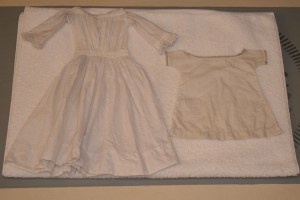 Work day one is at an end, but I’ve gotten side tracked, and all I’ve managed to get done is the laundry! That has a very familiar ring to it. At least this laundry is a lot more fun than the run of the mill dirty t-shirts and jeans.
I generally buy my Orvus and sodium perborate from Mini-Magic. A friend of mine recently found sodium perborate for sale on eBay at a good price, so you might want to check there too. She also located some at The Chemistry Store.