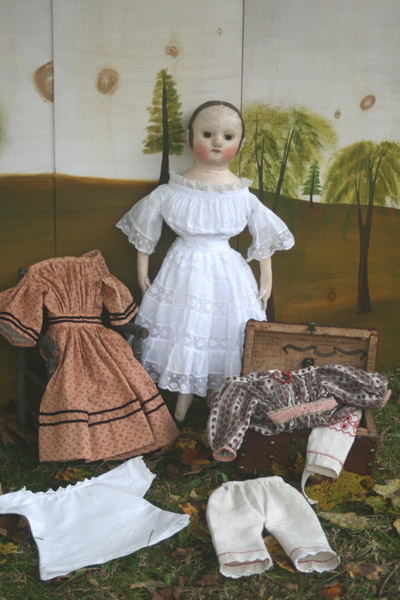
Izannah Walker was born 194 years ago today on September 25, 1817. Happy Birthday Izannah! To commemorate the occasion I’ve created a special Izannah Birthday Doll with an outstanding eleven-piece wardrobe. I’m also having a birthday sale, from today 9/25/11 through next Sunday 10/2/11, all reproduction Izannah Walker dolls, Izannah Walker Doll Making Classes, Izannah Walker Doll Clothes Patterns and Spun Cotton Ornament Classes are 10% off. This sale includes custom order dolls and as always you are welcome to place items on lay-away. If you have any questions, want to place an order, or would just like to chat about Izannah and her dolls and mine, I can be reached at 860-355-5709 or paula@asweetremembrance.com.
Izannah Birthday Doll
SOLD - Birthday doll and her wardrobe.
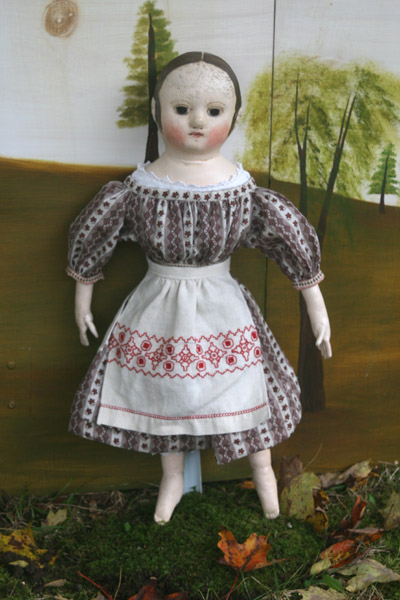
Even though I was rushing to beat the rain and falling darkness, I had the best time yesterday taking photos of this doll. It was great fun to “play dress up” with her. Her extensive wardrobe includes three dresses, two chemises, two pairs of pantalettes, two petticoats, an apron and a real coral bead necklace. If you’d like to add more pieces to her wardrobe I can make her hand made leather shoes, a cotton sunbonnet and a straw bonnet.
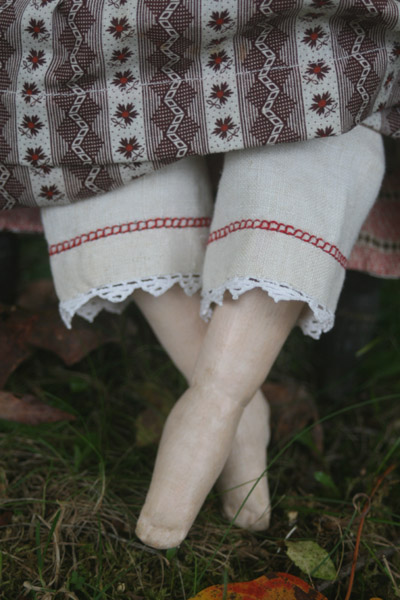
SOLD - This dress has wonderful sleeves, notice the rows of gathers at the top of the sleeve by the shoulder line.SOLD - This view shows the yards of 1/8th inch velvet ribbon encircling the sleeves, skirt and waistband.SOLD - The fabric for this dress is a very old 24 inch wide pumpkin orange on white print with small brown leaves and red berry dots.SOLD - Here she is wearing her brown and red dress, which is made from another fantastic early fabric.SOLD - She comes with a real coral necklace, which matches the Turkey red embroidery on her linen apron.SOLD - This view shows her tiny stitched toes peeping out from beneath her pantalettes. The pantalettes have Turkey red embroidery to match her apron and crocheted lace in a triangle pattern that echos the zig-zag stripes in her dress fabric. Look at the coordinating fabric lining the "false hem" of her dress.SOLD - She's all dressed for a party in this sheer cotton dress embellished with row upon row of lace insertion.SOLD - Two long ringlets curl in front of each of her ears. Thank you for looking!
To read more about, or purchase this doll please visit my website A Sweet Remembrance. I’d be happy to answer any questions you may have or provide additional photos, just ask 🙂 860-355-5709 paula@asweetremembrance.com.
Make a Wish
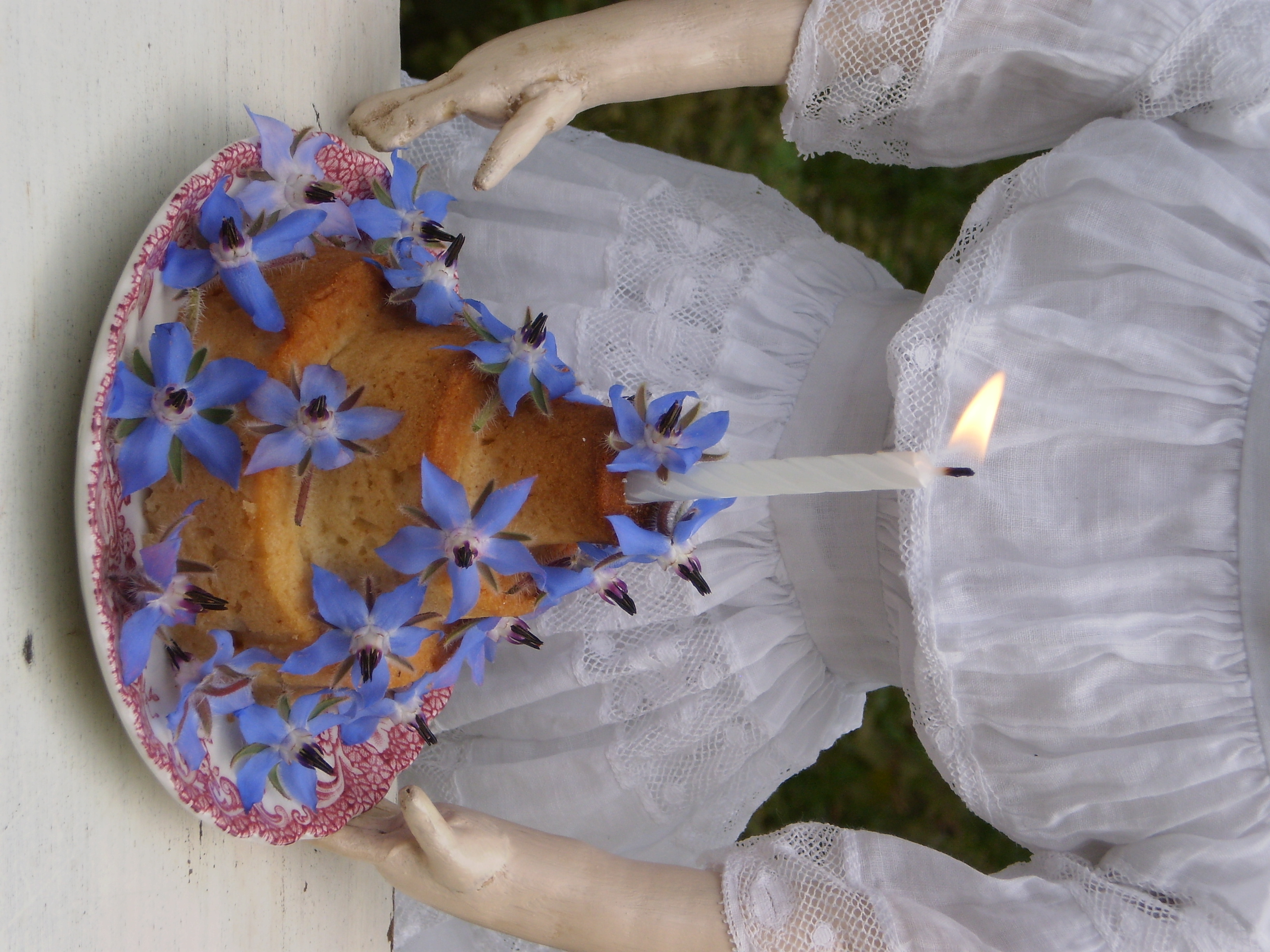
Birthday pound cake decorated with fresh borage flowers.
This year the girls and I baked a pound cake for Izannah’s birthday using a c.1754 receipt that I found in The Williamsburg Art of Cookery. This receipt is old enough to have been a well loved family favorite by the time Izannah was born. Here’s the recipe so that you can bake one too.
Pound Cake
Beat one Cup of Butter to a Cream, slowly beat in one and one third Cups of Sugar. Add one Teaspoonful of Mace and beat in five whole Eggs, adding them one at a time. Sift in two Cups of Flour, turn at once into a greased and floured Pan or Mould and bake slowly for one Hour.*
*I baked my cakes in a 300 degree oven, 30 minutes for the doll size cakes and two hours for the larger version.
Many articles have been written about Izannah Walker and her hauntingly beautiful, iconic cloth dolls. I have found all of them extremely interesting and well worth reading. However, it occurred to me that none of the articles that I have seen were written by someone who has actually made full size reproductions of Izannah’s pressed cloth heads and has experienced first hand the joys and frustrations of this unique type of doll making. So I’ve decided to join the ranks of doll lovers and historians who have gone before me in writing about this fascinating woman and her exceptional dolls.
It feels like I have loved Izannah Walker dolls for my entire life, although I know that can’t be true. When I look back, I think that I first became aware of her dolls right around the time that we moved to New England, 22 years ago. I do know that I have loved, and always wanted to own, antique dolls since my very early childhood. As soon as I knew that such things as really old dolls existed, I wanted one (or more!).
Izannah Walker and her dolls hold a very special place in doll history. On November 4, 1873, she was the first woman to receive a United States patent for making dolls.
Izannah Walker was born in Bristol, Rhode Island on the 25th day of September in 1817. I have read there is documentation that she started making dolls in 1828. She would have been 11 years old in 1828, the same age that I was when I first learned to sew. Norma H. Robertson, Izannah Walker’s grand-niece, stated that her great aunt began making stockinette dolls in 1845 for friends, and as her business developed, she put her three sisters to work painting faces. Other research and information that I have seen states that Izannah had two sisters, plus several older half-siblings, and that Izannah, her older sister Jane and her aunt Jane Hintz were all three doll makers.
One of my favorite Izannah stories is a reminiscence by Mrs. Helen Pierce of when the Walker sisters were living on Main Street in Somerset Village, MA. Mrs. Pierce tells a tale of the Walkers hanging their dolls out on the clothesline to dry when it was too damp in the house and how the air in the neighborhood was then permeated with the smell of oil paint. I can certainly relate to that, having hung my share of dolls out on the clothesline.
The Mystery of Molds and Lessons Learned About Pressed Cloth Heads
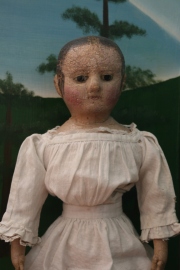
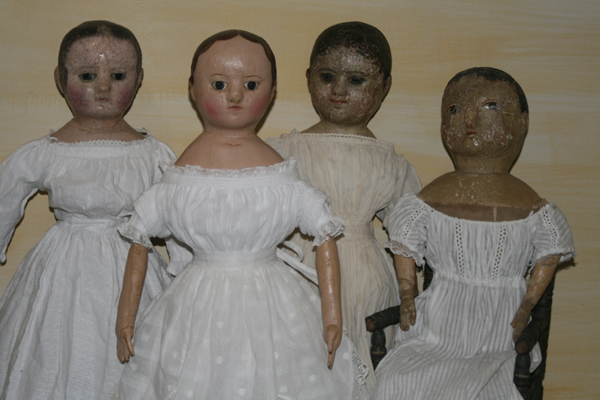
One of the things that I find most endearing about the Walker dolls is their differences. This may be because three individual women had a hand in their construction, either working together or apart. It is also, in my opinion, a very basic fact of life when a doll maker is creating dolls with pressed cloth heads. While all of the original dolls are recognizable as Walker dolls, they do come in many sizes, from 13 to 27 inches* in height, and often have very striking differences from one another. The majority of the dolls are girls, although there are a few boy dolls and even fewer black dolls with lovely, short, nubby black wool hair.
There has been a great deal of speculation in the doll world about the number and origin of the molds Izannah Walker used to make her dolls. I can’t offer any clues about how the molds were made. Did she sculpt her own prototype heads and then have them made into metal molds? Did she hire others to create both the original sculpt and molds? Or did she commission molds from commercially available European dolls? Her patent information shows the use of a metal mold and dye, but did she always use metal molds? Is it possible that her earlier dolls were created using plaster molds, which were long established in the doll making industry at that time, and would wear out and need replacing more frequently?
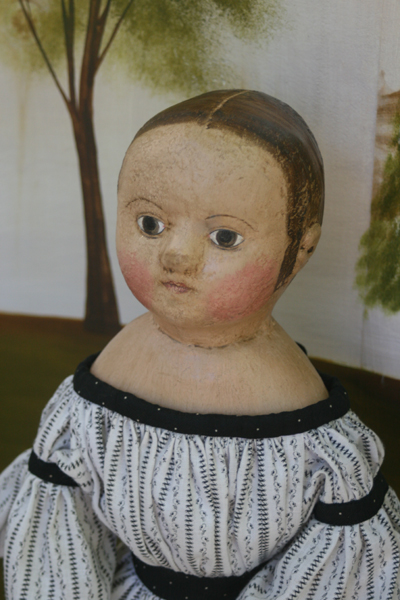
Example #1 of dolls with pressed cloth heads made from the same mold.Example #2Example #3Example # 4Example #5Example #6 Notice how much rounder and fuller the cheeks are on this doll.
What I can say with some confidence is that it is very likely that she used fewer molds than many people think. Obviously, she had to have a variety of molds for the different sized dolls that she made and it is equally obvious that her early dolls used very different molds than her later, patented dolls. What I have found when making pressed cloth heads is that heads made using the same mold will turn out quite differently from one another. When making pressed cloth heads, you do not get the same consistency as you do when casting materials, such as bisque, papier-mâché and wax, that can be poured into a mold and hardened. Izannah’s pressed cloth heads were made in sections that had to be joined together, a process that sometimes causes individual heads to come out a bit larger or smaller than each other. After the front and back sections of the head were sewn and or glued together, the head was stuffed with cotton, horsehair, sea grass or other materials. The pressed cloth heads are not rigid like the heads of a china or porcelain doll. They are somewhat flexible and their shape can be altered by how tightly the stuffing is packed into the head. All of these factors can and will change the appearance of the finished pressed cloth head.
Photo taken with Canon Digital RebelPhoto taken with Olympus Digital FE-20 camera
Another point that I would like to mention here is that when studying photographs of Izannah Walker dolls, it is important to remember that the photographs do not always look the same as the doll does in person. I am by no means a professional photographer, but I am a person who takes an inordinate number of doll photos, using several different cameras and lenses. The type of lens used to take a photograph will have a big impact on how the doll looks, as will the lighting and angle from which the photo is taken. People who have only seen Izannah Walker dolls in photographs are often very surprised when they first see one of the dolls in person. The dolls are smaller and much more delicately proportioned than they often look in photos. Their eyes are not as large and their foreheads aren’t quite as curved and pronounced as people expect. I am fortunate enough to have been able to visit several museums and view dolls in person that I had previously only seen in photos and I can attest that there is a real difference. I see this same difference when I photograph both my antique Izannah Walker dolls and the reproductions of them that I make. So some Walker dolls may look more similar in person than they do when compared in photographs. Especially when they are photographs taken by different people, using different cameras, lighting, etc.
Photo taken with an Olympus FE-20 digital cameraPhoto taken with a digital Canon Rebel camera
The painting style is another variable from doll to doll. Again, this may be due to more than one person wielding her brush, or it may be because when a doll maker paints a doll, each one is slightly different from the next. Even if you have never made a doll in your life, I’m sure that you can relate. Think about your signature. It is something you do over and over again. Is it exactly the same every time? When you make your favorite recipe, the one you know by heart and don’t have to look up, does it turn out just the same every time? Izannah Walker’s dolls were made over a long period of time. Even if a single person painted them all, it is natural that they would change. When I paint my dolls, the colors will vary a bit since I don’t use a “recipe” to mix my paints. Some days, I paint finer lines than others, paint better curls, make more blushing cheeks and crisper bootlaces. Such is the nature of hand made artistry and it is why Izannah Walker dolls are so well loved and enduring. The hand of the doll maker shows in each and every one of them. They are similar and yet individual works of artistry.
I like to think that the women all worked together, even when they were separated by distance (which they were during different periods in their lives). My sister and I make reproduction samplers together, even though she lives in Nebraska and I live in Connecticut. Both of us work on every sampler that we make, each doing our own part to create the final product. It would have been possible for the Walker sisters and their aunt to do the same, and I hope that they did. My sister and I enjoy working together and I’d like for the Walkers to have had the bond that shared goals and joint work brings about.
Construction Features of the Walker Dolls
Like any other reproduction-sewing project, making an Izannah Walker doll is an eye opening experience to the difference between 19th century and 21st century sewing construction. People in the 1800’s obviously viewed pattern making and sewing construction differently than we do today. The shapes of many of the pattern pieces used to make these dolls and their clothing are unfamiliar to modern seamstresses.
Izannah’s earliest dolls had heads that were made of molded and pressed cloth joined to the bodies at the neck. This is different than the later patented dolls that had molded and pressed cloth heads and shoulder plates that were glued onto the bodies. I think the early dolls are prettier than their later sisters, and they are the type of Izannah Walker dolls that I prefer to reproduce. The front of the pre-patent doll’s head is joined to the back just in front of the ears. The back of the head has a partial center seam.
Often you will see that the dolls have repaired ankles. This is because they have a seam at the ankles that connects the foot to the leg. Modern cloth dolls are seldom made this way. The dolls have narrow waists, with wide shoulders and hips. The unpainted portions of their bodies are covered with a “second skin,” which gives them a neat, finished appearance, and points to the care with which they were made.
I find all of these details intriguing. They are part of what draws me to study Izannah Walker’s dolls and have kept my interest in them so strong for many years.
Izannah Walker dolls were made using molds. That does not mean that they took less work or are less desirable than a doll that has a one-of-a-kind sculpted face. For me, understanding how the Walkers made their dolls and using those same techniques to make dolls of my own gives me an even deeper love and appreciation for the originals. Through years of experience, I know exactly why some of the dolls have that characteristic crease at the hollow of their throat, why the paint on the earliest dolls cracked and peeled, why the hands have such a wonderful shape and how to make that slight curve at the wrist. I treasure the experience, the knowledge and the insight and I would urge you to try your hand at making a doll using Izannah’s methods. It will give you a wonderful glimpse into her world and her art.
Collection of the author
Izannah Walker managed to capture an evocative moment of American history and very firmly convey a sense of her time and place in a child’s toy. These toys continue to be treasured, loved and marveled at today.
* There are rumors of a “life-size” doll that was owned by members of the Walker family.
Sources for some of the information used in this article and additional reading:
American Folk Dolls by Wendy Lavitt (Knopf 1982)
American Rag Dolls Straight From The Heart by Estelle Patino (Collector Books 1988)
“An American Master of Cloth” by Helen Nolan, Dolls, February 1995 (this article is about Martha Chase and only has a brief mention of Izannah Walker)
“The Art of Dolls 1700-1940” by Madeline Osborne Merrill, Doll Reader, April 1985
Cover Photo by Dorothy McGonagle, Doll News, 1989
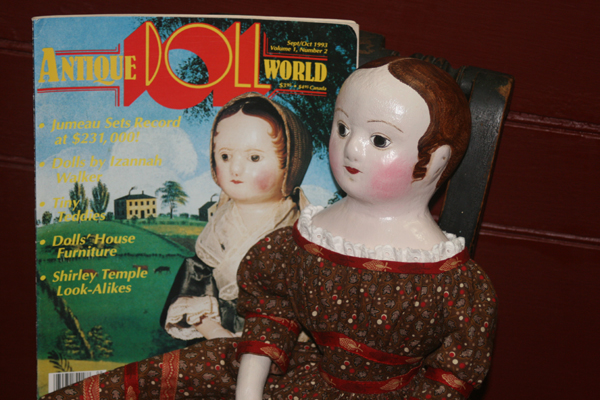
“Dolls by Izannah Walker” by Donna C. Kaonis, Antique Doll World, September/October 1993
The Doll Collection of Helen Gage, Auction Catalogue by Marvin Cohen Auctions, December 1984
“Dolls of Rhode Island” by Carolyn Guise, Two Hundred Years of American Dolls, The New London Doll Club United Federation of Doll Clubs Region Fourteen Meeting, May 1977
Early American Dolls in Full Color, by Helen Nolan (Dover Publications 1986)
“Early American Stockinette Dolls: Part 1- Izannah Walker and Martha Chase Dolls” by Judy Beswick, The Cloth Doll, Fall 1998
Encyclopedia American Dolls by Ruth S. Freeman (Century House 1952)
“The “Holy Grail” of Early American Dolls” by Catherine Riedel, Yankee magazine, November/December 2009
“Izannah Walker – Godmother to Cloth Doll Makers” by Susan Hedrick, Soft Dolls & Animals, Summer 1998
“Izannah Walker’s Iconic Dolls” by Edyth O’Neill and Dixie Redmond, Early American Life, Christmas 2011
“An Izannah Walker Reunion” by Carol Corson, Antique Doll Collector, August 2011
“Izannah Walker: The Mystery Deepens” by Helen Nolan, Dolls, August 1994
“The Little Doll With The Little Curl” by Maurine S. Popp, The Jenny Lind Doll Club of Southern Connecticut Region 14 of The United Federation of Doll Clubs, April 1968
Made to Play House: Dolls and the Commercialization of American Girlhood, by Miriam Formanek-Brunell (Johns Hopkins University Press, 1998)
“The Mystery of Izannah Walker” by Helen Nolan, Dolls, September 1993
“The Search for Izannah Walker” by Monica Bessette, Doll News, Spring 1994
“Stitches in Time” by Diane Goff, Doll Reader, July 1993
Summer in Marseilles at the Turn of the Century Auction Catalogue by Theriault’s 1993
“They’re Just Down-Home Folk” by Wendy Lavitt, Dolls, May 1993
The Treasury of Beautiful Dolls, by John Noble (Weathervane Books, 1978)
“Walker Dolls: A Family Affair” by Monica Bessette, Doll News, Summer 1998
This article and the accompanying images, like all posts and photographs on this site, are copyrighted by Paula Walton and may not be published or reproduced in any form without the express written consent of the author.
Today is the 193rd anniversary of Izannah Walker’s birth, September 25, 1817 – February 15, 1888. Happy Birthday Izannah!!!
You made exceptional dolls and I think about you whenever I look at my own dolls that you made. Even after all this time and all the loving hands they have passed through, they still have the power to enchant everyone who encounters them.
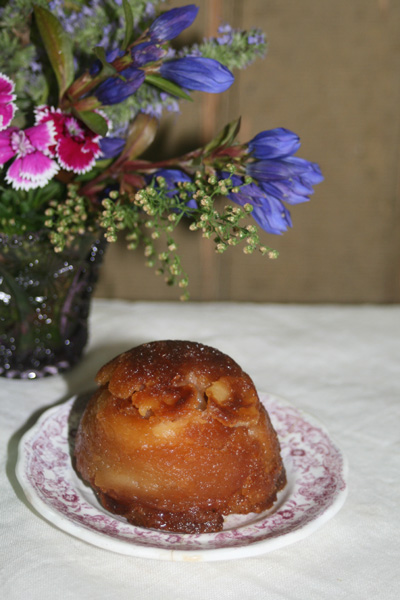
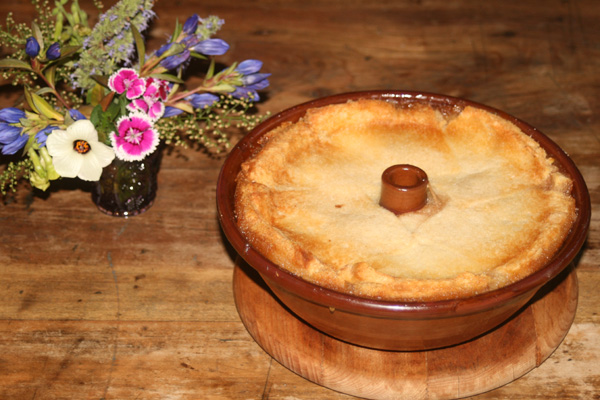
The girls and I decided that we needed to have a celebration today in honor of Izannah. I baked a Birth-day Pudding and plan to spend the day making a new batch of molded heads.
In case you would like to celebrate with us, here is the recipe for the pudding:
Birth-day Pudding
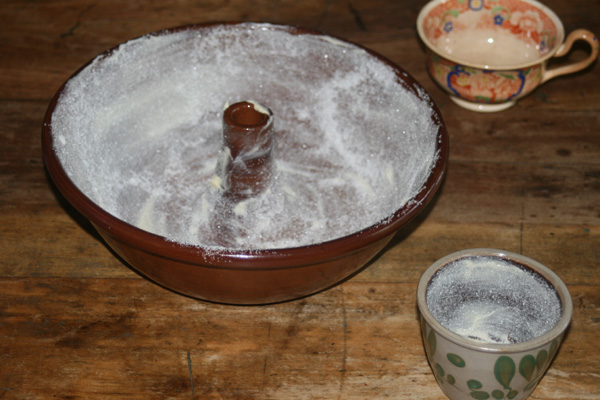
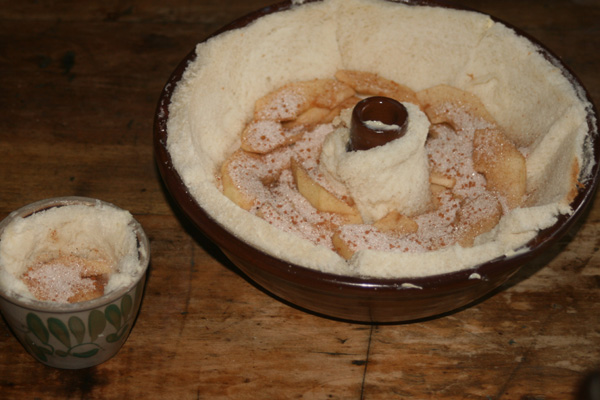
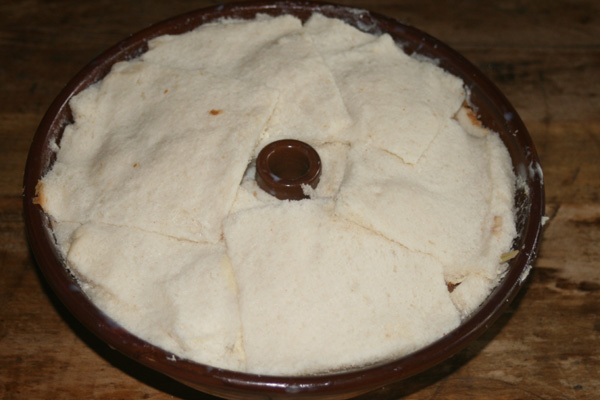
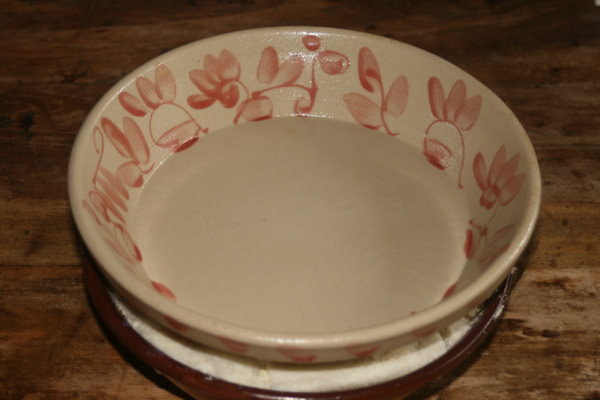
Butter a deep dish, and lay in slices of bread and butter, wet with milk, and upon these sliced tart apples, sweetened and spiced. Then lay on another layer of bread and butter and apples, and continue thus till the dish is filled. Let the top layer be bread and butter, and dip it in milk, turning the buttered side down. Any other kind of fruit will answer as well. Put a plate on the top, and bake two hours, then take it off and bake another hour.
This receipt (aka recipe) is from Miss Beecher’s Domestic Receipt-Book by Catherine E. Beecher. Catherine Esther Beecher was born in 1800 in East Hampton, Long Island. She founded the Hartford Female Seminary in 1823 as well as other schools for young women in Ohio, Illinois, Iowa and Wisconsin. She wrote A Treatise on Domestic Economy (1841) and Miss Beecher’s Domestic Receipt-Book (1846).
Notes:
After buttering my dishes I dusted them with sugar, before layering in the bread and butter.
I cut the crusts off my bread, as the pudding was for a special occasion, but you certainly don’t have to. I saved the crusts as a treat for the wild birds in my yard. You may also save them to make stuffings, bread crumbs, or croutons.
I chose cinnamon, mace and nutmeg as my spices.
I baked my doll sized pudding in a custard cup, which would also be nice if you want to bake yours in individual portions.
I preheated my oven to 350 degrees and baked my puddings for 15 minutes, then I reduced the oven temperature to 250 degrees and continued baking for the remaining 2 hours and 45 minutes. I removed my doll size pudding from the oven after 30 minutes of total baking time. Your baking time is going to depend a lot on the size of your dishes and the thickness of your pudding, so check your oven fairly frequently. It’s also a good idea to put a cookie sheet under your dish, because my pudding bubbled over as it was baking.
For any of you that would like to celebrate Izannah’s 193rd birthday by learning how to make dolls like Izannah made hers, I am having a special sale on my Izannah Walker Reproduction Doll Making Class by Mail. The class is on sale through tomorrow, Sunday September 26th at midnight, for $193.00. Its regular price is $250.00.
If you would rather celebrate by buying a finished doll, please contact me this weekend, September 25 & 26, to order your own custom-made reproduction Izannah Walker doll. I will give you a discount of 30% off of my normal prices, for any doll that you order today or tomorrow.
Email me at paula@asweetremembrance.com or call me at 860-355-5709 to describe what you want your doll to be like (distressed, pristine, fully dressed, au natural, boy or girl, accessories, etc.) and I will be happy to give you an exact price quote before you place your order. Because of all the variables that you may choose from it’s very hard for me to list prices, and I found out that people were getting confused, so call me or email me and I’ll talk you through the ordering process. Remember lay away is an option 🙂 !
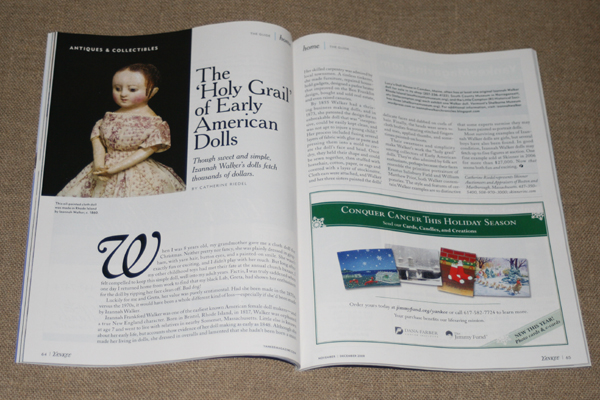
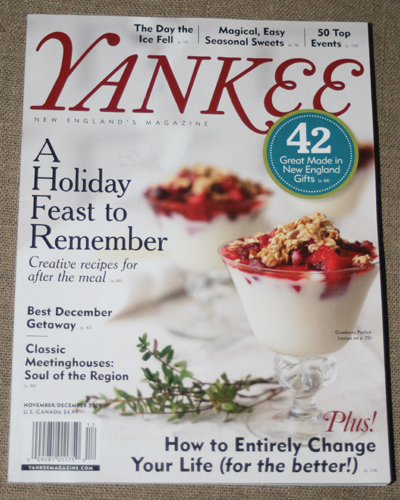
There is a very nice two-page article on Izannah Walker dolls in the current (November/December 2009) issue of Yankee magazine, written by Catherine Riedel of Skinner’s Auctioneers. Thank you Catherine for referring readers to this blog for additional information about Izannah Walker dolls.
If you happen to see a copy of the magazine for sale it is certainly worth purchasing. As an added bonus the magazine contains some interesting recipes for using up your Thanksgiving leftovers

 Izannah Walker was born 194 years ago today on September 25, 1817. Happy Birthday Izannah! To commemorate the occasion I’ve created a special Izannah Birthday Doll with an outstanding eleven-piece wardrobe. I’m also having a birthday sale, from today 9/25/11 through next Sunday 10/2/11, all reproduction Izannah Walker dolls, Izannah Walker Doll Making Classes, Izannah Walker Doll Clothes Patterns and Spun Cotton Ornament Classes are 10% off. This sale includes custom order dolls and as always you are welcome to place items on lay-away. If you have any questions, want to place an order, or would just like to chat about Izannah and her dolls and mine, I can be reached at 860-355-5709 or paula@asweetremembrance.com.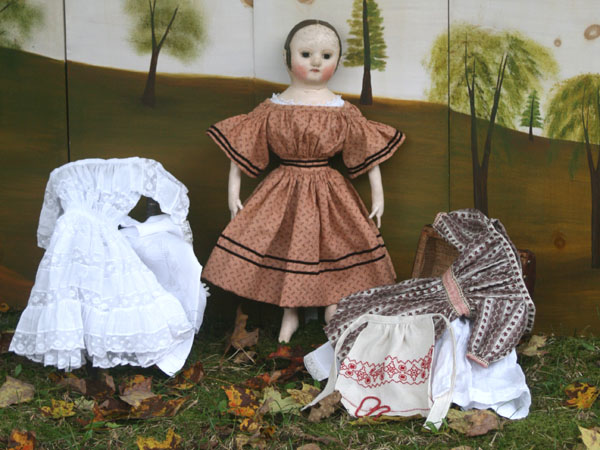













 Izannah Walker Journal