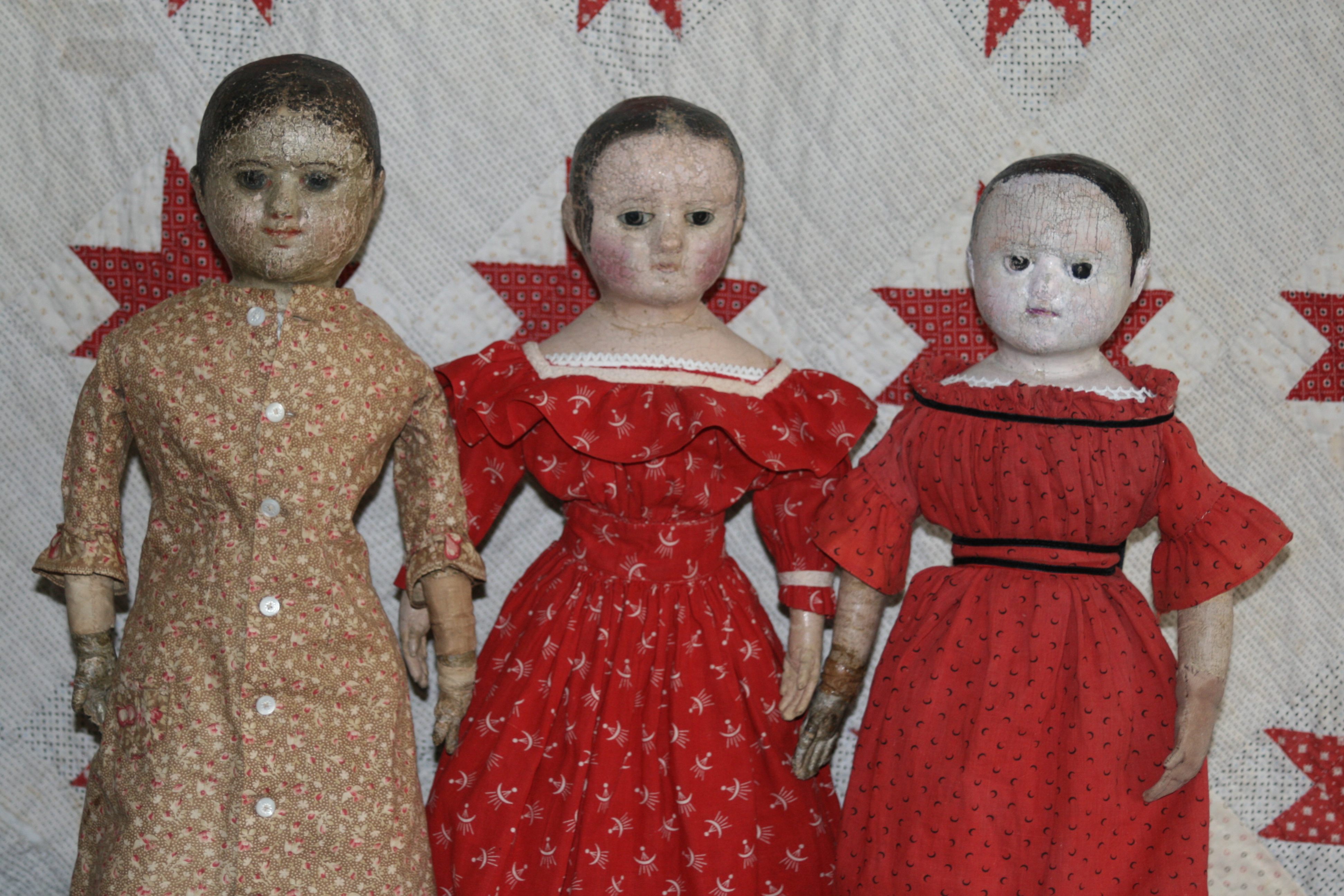
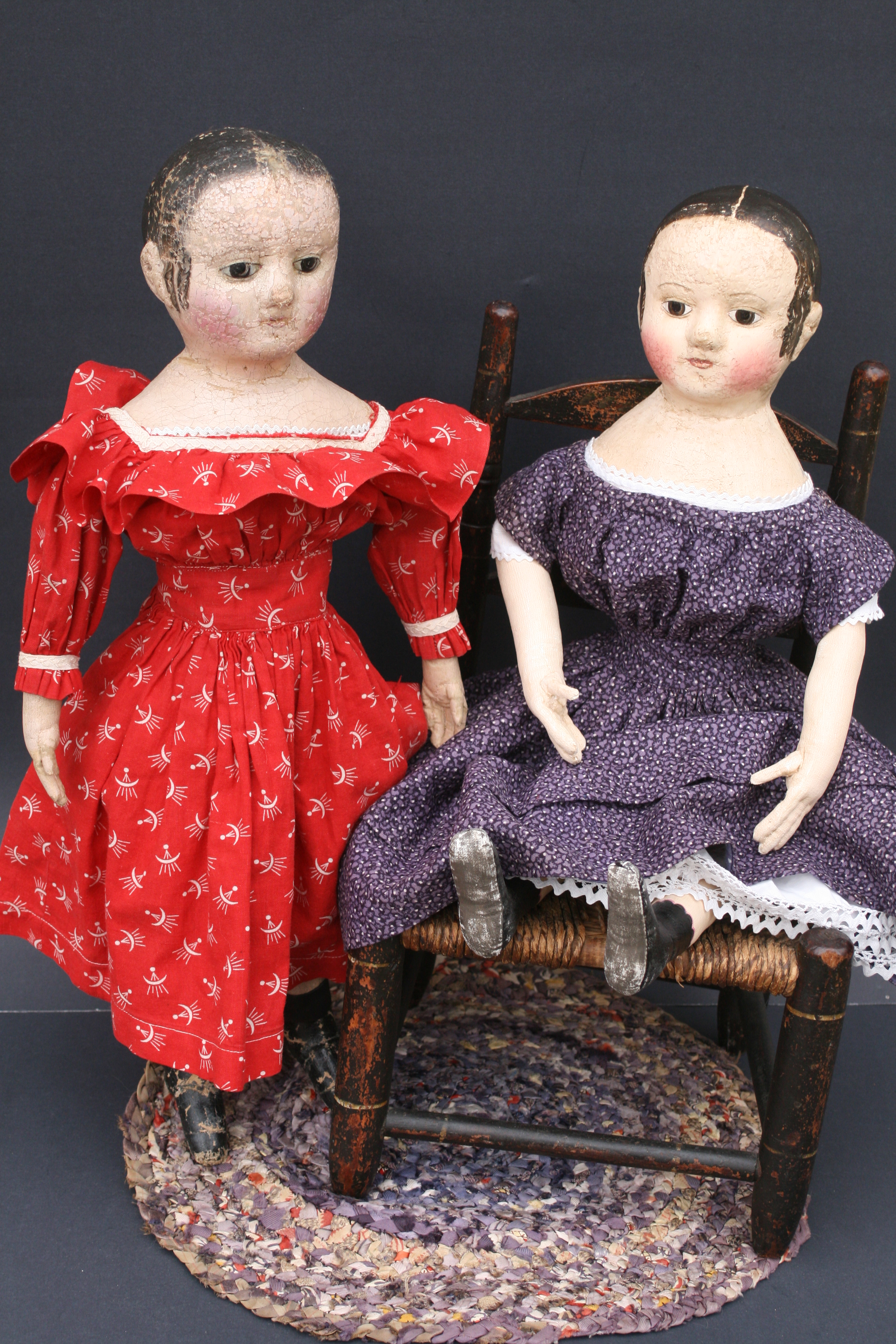
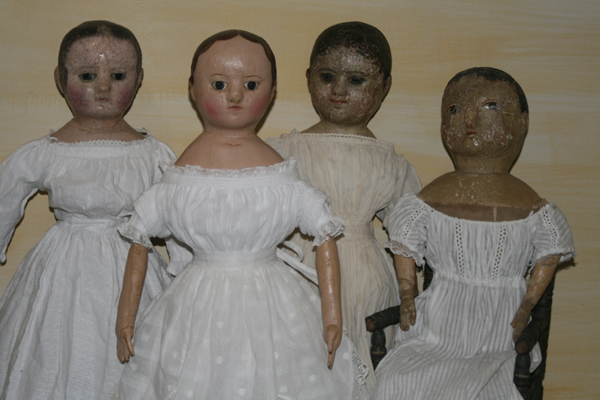
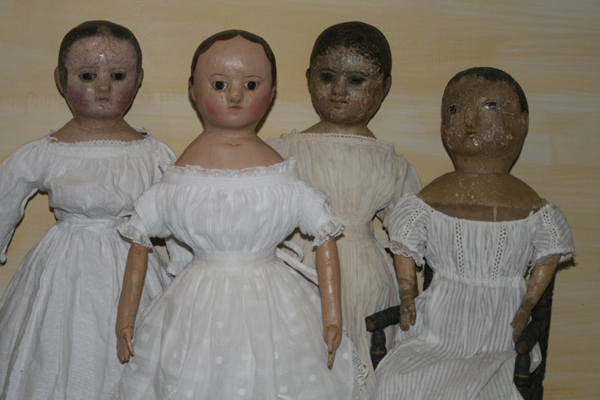
Three little maids all in a row! My two antique Izannahs are on the left and Mary’s doll, Anna, is on the right.
I’ve had a wonderful weekend. On Friday Mary and her antique Izannah Walker doll, Anna, came to visit. Mary and I had an excellent time comparing our dolls to one another, talking about Izannah Walker and her dolls, and planning a wardrobe for Anna.
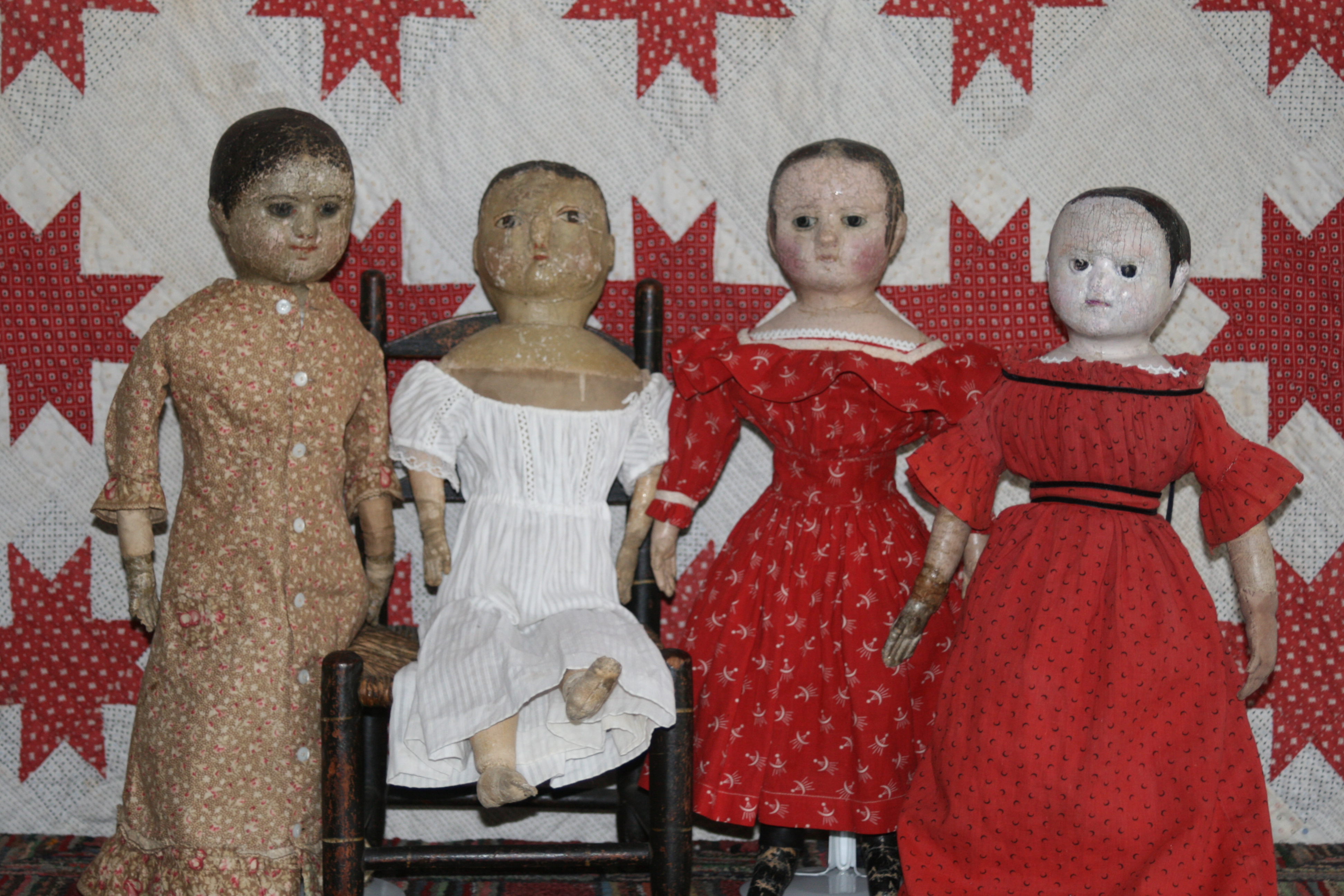
Here is a treat that I don’t often get to see! Four antique Izzies all tucked up together in an antique cradle!
All of my Izannahs were just as excited as can be when Anna got to stay for a sleep over! It was hard to get them to settle down for the night. They had so much to talk about! The girls and I hope that Mary and Anna had as much fun as we did 🙂
My three dolls just hated to say good-bye to little Anna!
It feels like I’m always rushing from one deadline to another. I’ve spent the past few weeks working on several new dolls for a photo deadline. I finished this doll today, just in time to rush her photographs down to the post office before they closed, getting them post marked on the very last possible day!
Actually this doll is one I had been planning to have finished before Early American Life came to our house in December. For some reason people always have the mistaken idea that I have shelves full of dolls, spun cotton ornaments and all of the other things that I make to sell. They imagine that coming here is like going to a secret hidden shop full of treasures, set inside the perfect 18th century New England farmstead… This is so far from reality ! 🙂 I normally don’t have any dolls here at all, unless there are one or two on lay-away. In real life most of my dolls get packed up and shipped just as soon as I get the last stitches finished. Plus doll making is messy, so my studio rarely looks tidy and there is a trail of thread and fabric snippits leading from the studio, across the yard, to the house, and into the parlor, where I sit in the evenings to do hand sewing. So part of my grand plan, when Early American Life asked if they could come photograph our house at Christmas, was to create three or four new dolls and a whole tree full of ornaments. None of them actually got finished 🙂 . By the time the retreat was over and I kept up with orders, then cleaned and painted throughout the house like a mad woman, there was no time left! So I postponed making this doll until my latest deadline instead.
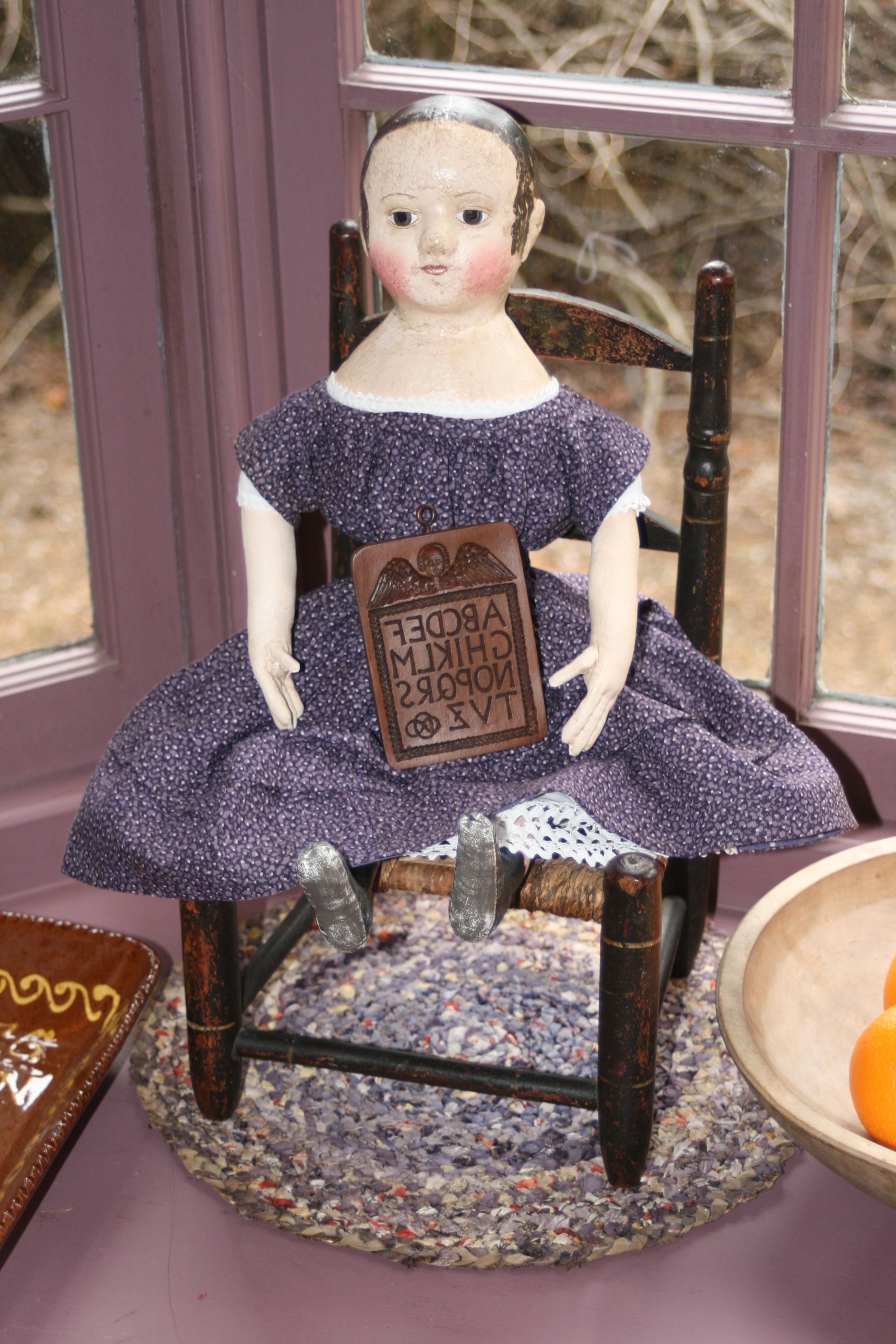
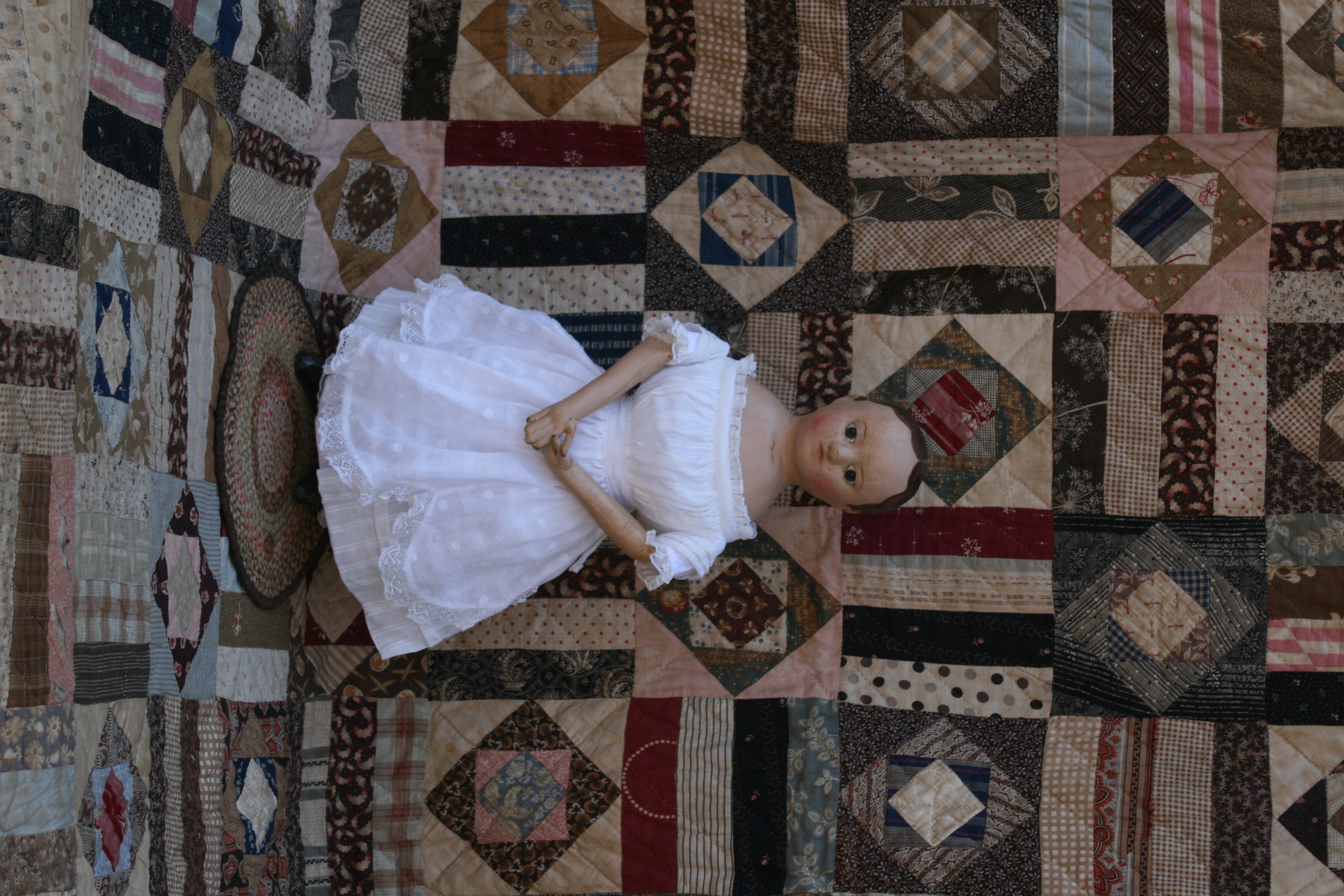
Now that she is finished, she will be keeping me company in my kitchen. I created her for myself, incorporating all of my favorite Izannah details. I even added a third ringlet in front of each ear, like the ones on the lovely antique Izannah that was just up for sale on eBay last week. I doubt that I will ever be able to afford the $22,000.00 opening bid on the eBay doll, but I decided that I can treat myself to one of my own dolls.
My c. 1860 antique Izannah Walker doll in red, on the left, and her newly made offspring c. 2013 dressed in dress made of rare “double violet” mid-19th century fabric, on the right.
Tomorrow is going to be another busy day in my studio, as I move on to more orders and deadlines, but for tonight I am relaxing and enjoying my new Izannah, with nothing more taxing to do than decide upon the perfect name for my newest friend…
A steadfast new friend to share in my kitchen adventures!
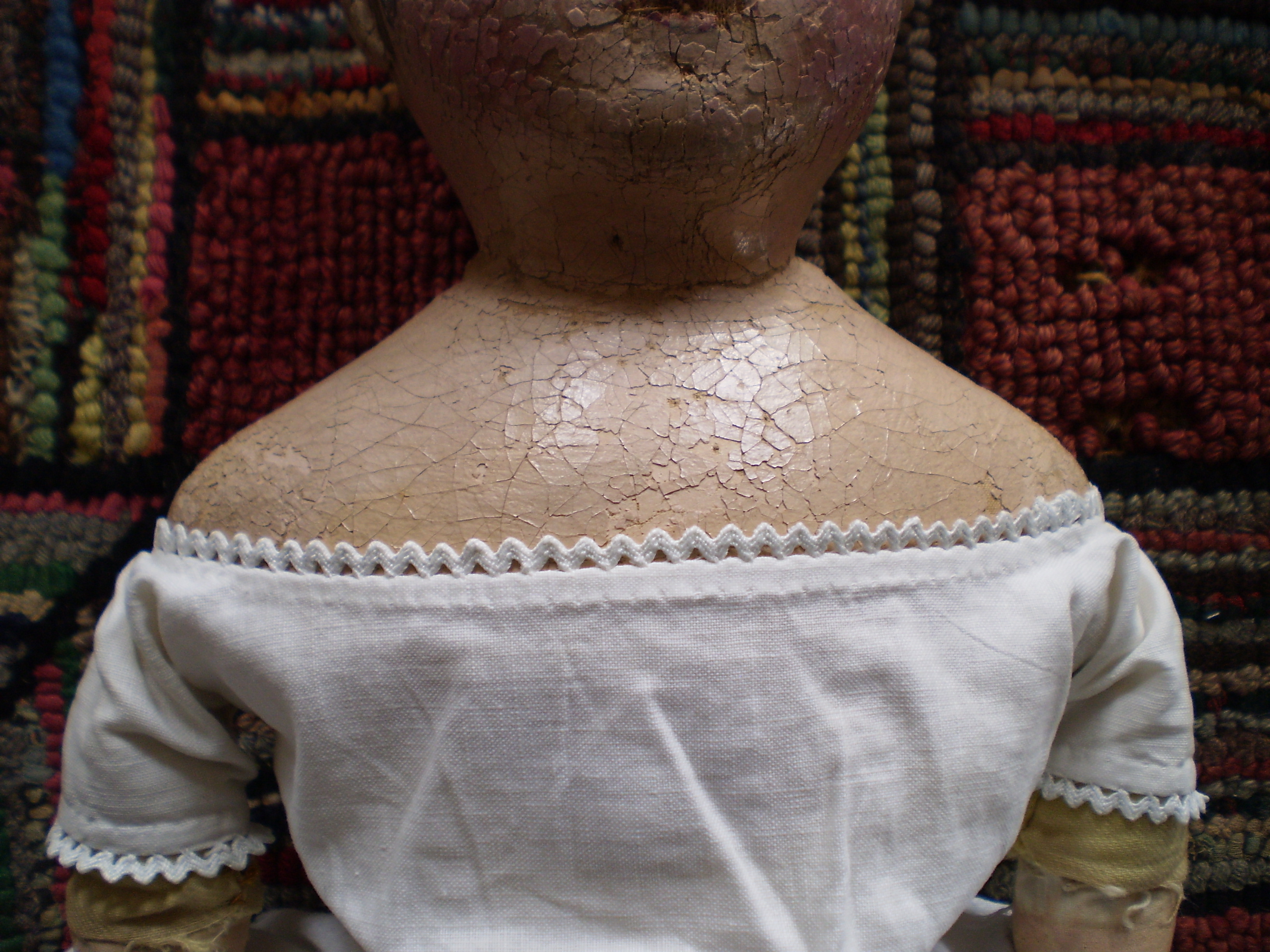
Several months ago when I was working on Anne Marie’s doll, I developed a method of transferring the paint surface from the shoulders of my original antique Izannah Walker dolls to the cloth shoulders of the reproduction dolls that I make. I was really striving to make Anne Marie’s doll blend in with the other dolls in her collection, since she only owns antique dolls and my doll would be her first reproduction.
I’m very pleased with the results that I managed to achieve. I basically wound up doing the equivalent of theatrical make-up, using artist mediums (making me really happy that I’d taken that theatre make-up class in college) 🙂
In these photos you can see one of my antique Izannah Walker dolls on the left, c.1860, and my newly made reproduction doll, c. 2012, on the right. I love old, original paint surfaces! You can probably tell that, right???
I am currently working on three dolls, all of which have more refined, less distressed surfaces. I would say that they will be finished soon, but with one of my sons getting married in 25 days my work schedule is in serious disarray! Especially since I am working feverishly on Paula C.’s custom order doll too…
If you would like me to send you an email to let you know when I have finished dolls available for sale, just ask. I would be happy to add you to my “new dolls” list if you email me at paula@asweetremembrance.com. You can also email me with any questions you may have about my dolls, or if you’d like to discuss having me make a doll to your custom specifications. I love taking a break to “talk” about dolls!
The Doll Collectors of America have a wonderful Izannah Walker slide show of their 2010 75th Annual Meeting online. It is most glorious thing I’ve seen lately! If you need to add a few moments of happiness to your day, go take a look 🙂 Click here or on the link above.
Several people have asked me about additional Izannah dress styles lately. This slide show has some lovely dresses in it, which makes it a fantastic resource too. If you have any questions about the possibility of ordering a dress similar in style to any dress you may have seen on an Izannah Walker doll, just ask. I can make almost any dress that I can find the materials for 🙂
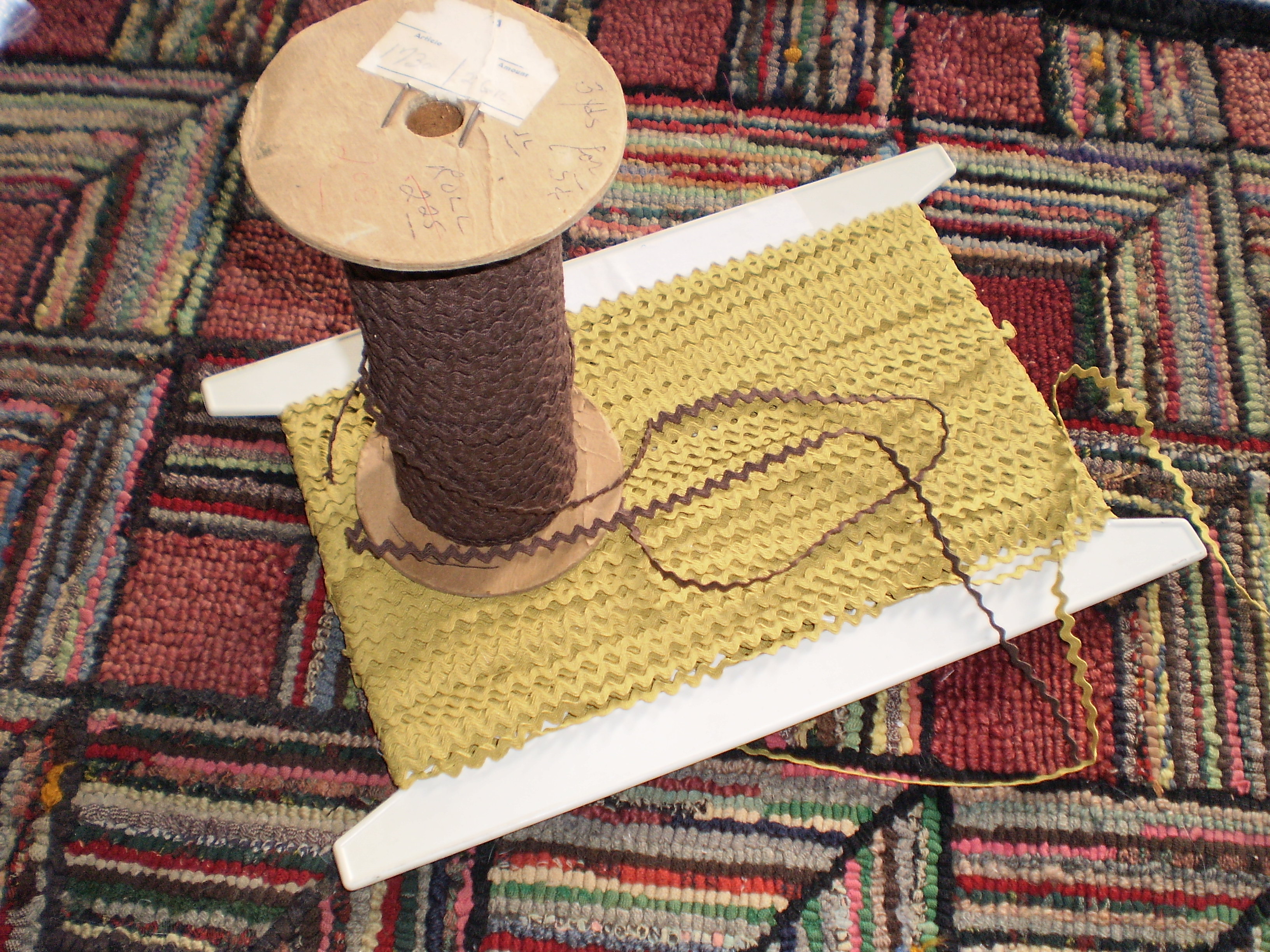
I’ve always been rather fond of rick rack. It reminds me of my childhood. The dress I wore to my first day of kindergarten was trimmed with white rick rack and I remember seeing it on countless aprons and kitchen curtains during my youth.
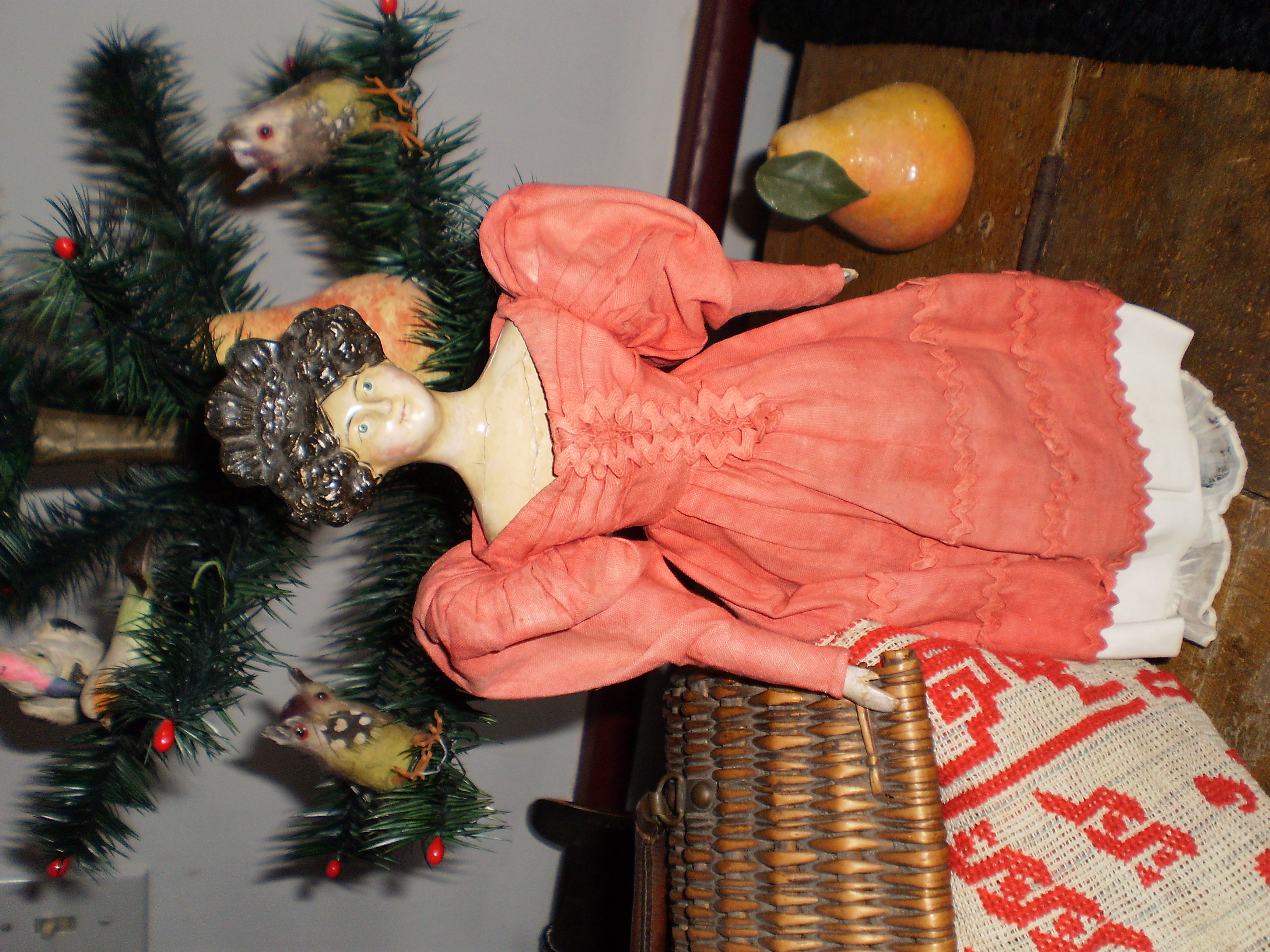
In truth, rick rack or waved braid, as it was first known, has been in existence far longer than I have. 🙂 I haven’t been able to track down an exact date yet, but it was certainly available when this papier-mache milliner’s model was made in the 1830’s.
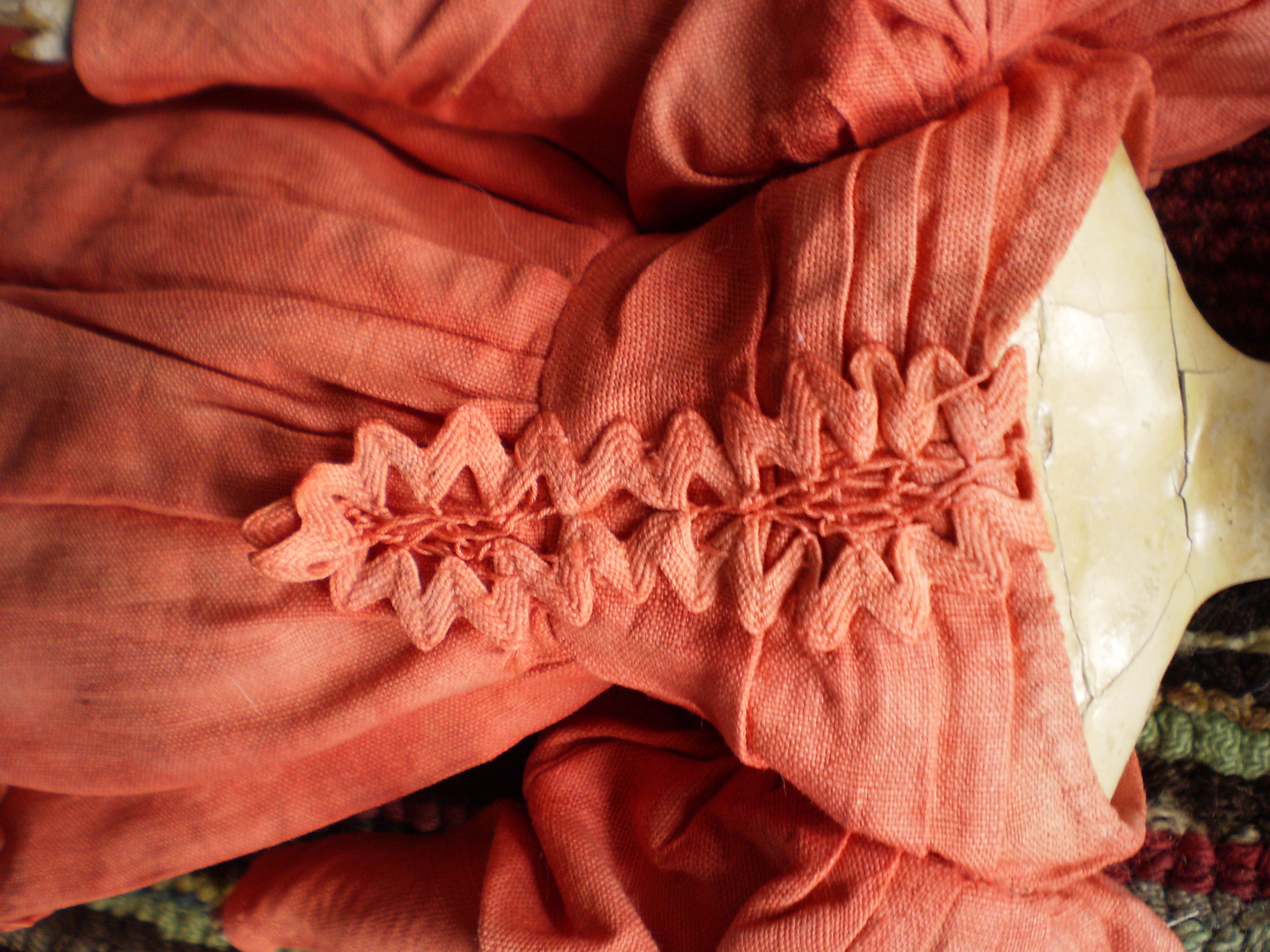
The waved braid on the dress above is an exact color match to the dress fabric. Both the braid and fabric are cotton and I am speculating that they were dyed to match. The dress is original to the doll. Three rows of waved braid circle the skirt and the bodice is adorned with a lavish combination of braid and knotting.
Waved braid and knotting trim the bodice of this 1830's doll's dress. (click on image to enlarge) Collection of the author.
By 1882, when the following paragraph from The Dictionary of Needlework was published, waved braid was certainly common place and was being used to trim children’s clothing. It’s not a far leap from children’s garments to doll clothes, which explains why waved braid is often seen on doll clothing from this era.
“There are also waved cotton braids, used for trimming children’s dresses, which are sold by the gross, cut into lengths. The numbers are 11, 17, 21, 29, and 33. There are also waved worsted braids for children’s use, which are sold in knots of 4 or 5 yards each, and sold by the gross pieces. The numbers are 13, 17, and 21.”
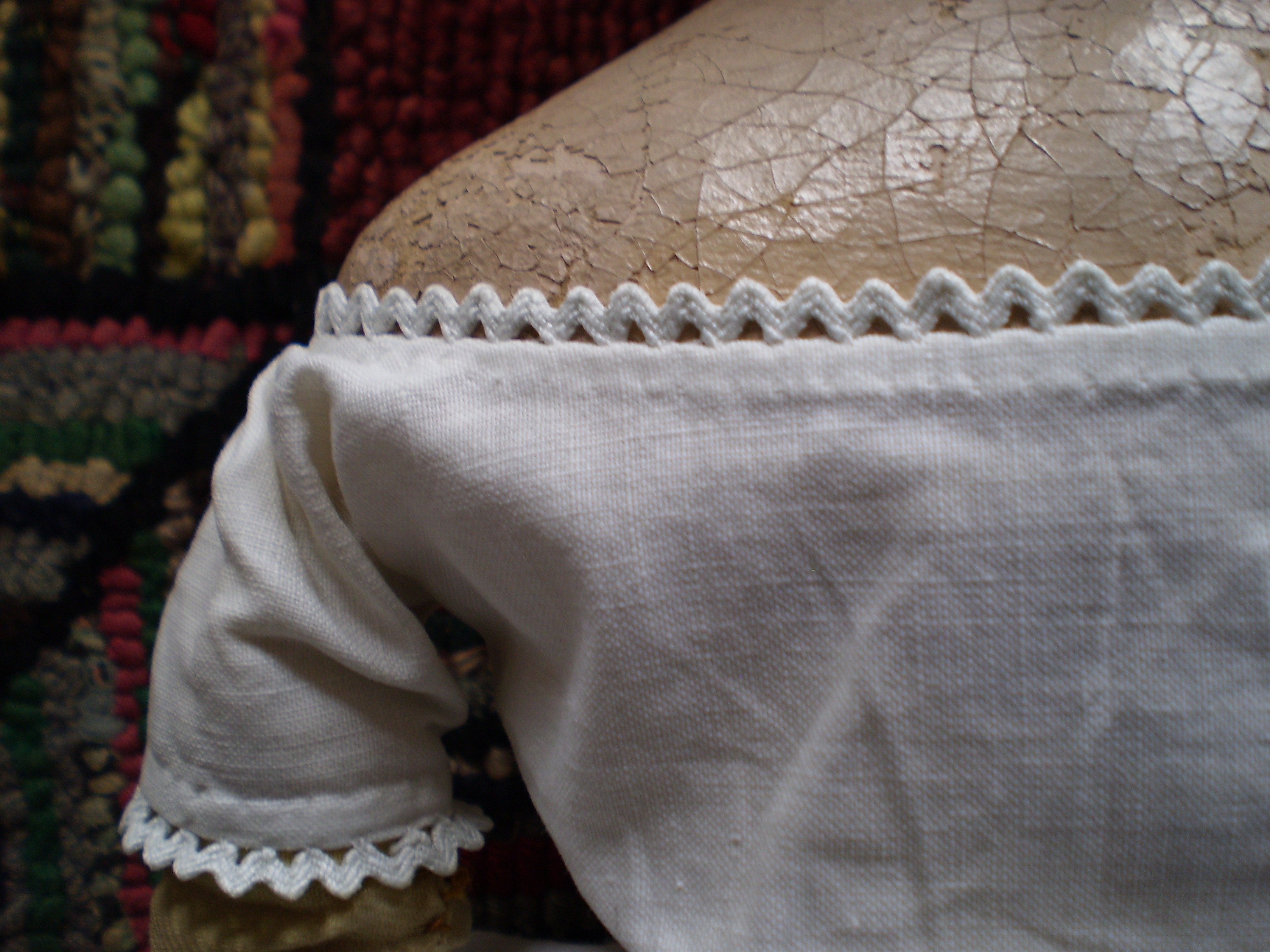
Waved braid trimming the neck and sleeve edges of the original chemise that belongs to one of my antique Izannah Walker dolls.
In the 1880’s it was also popular to do crochet work using waved braid. Some fantastic laces can be created in this manner. I don’t crochet, but if you do and would like to read more about how to make this type of lace, follow this link.
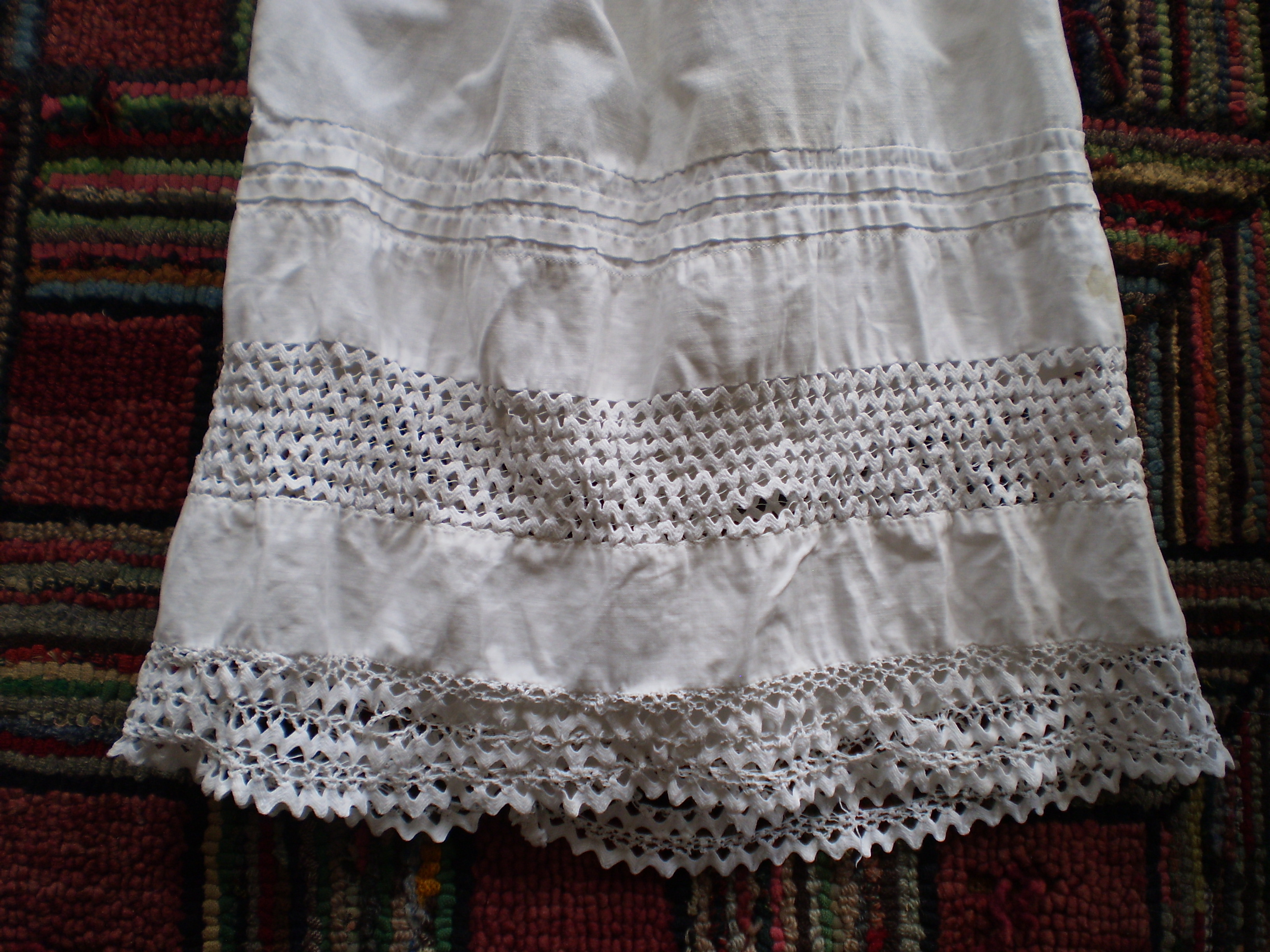
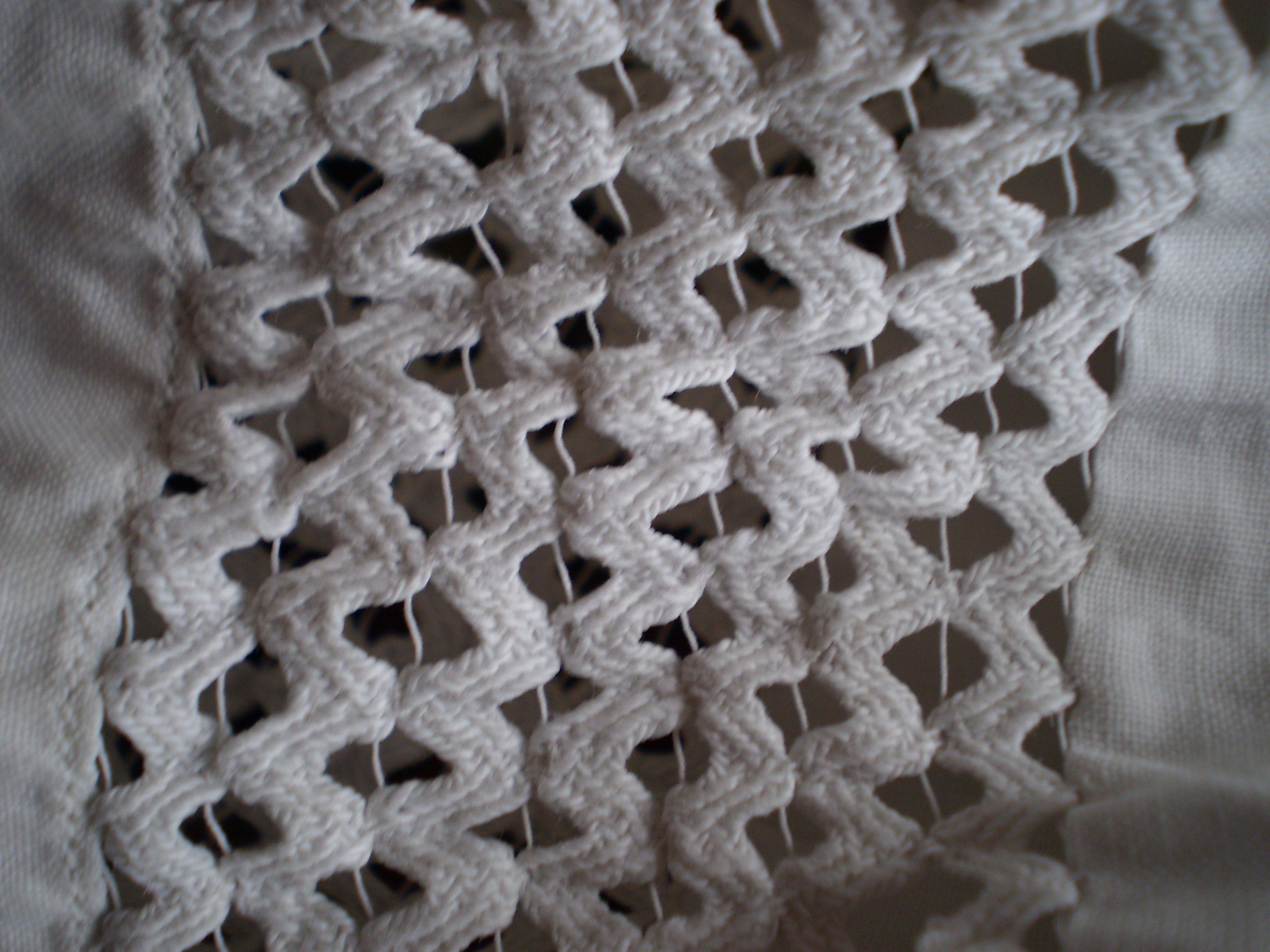
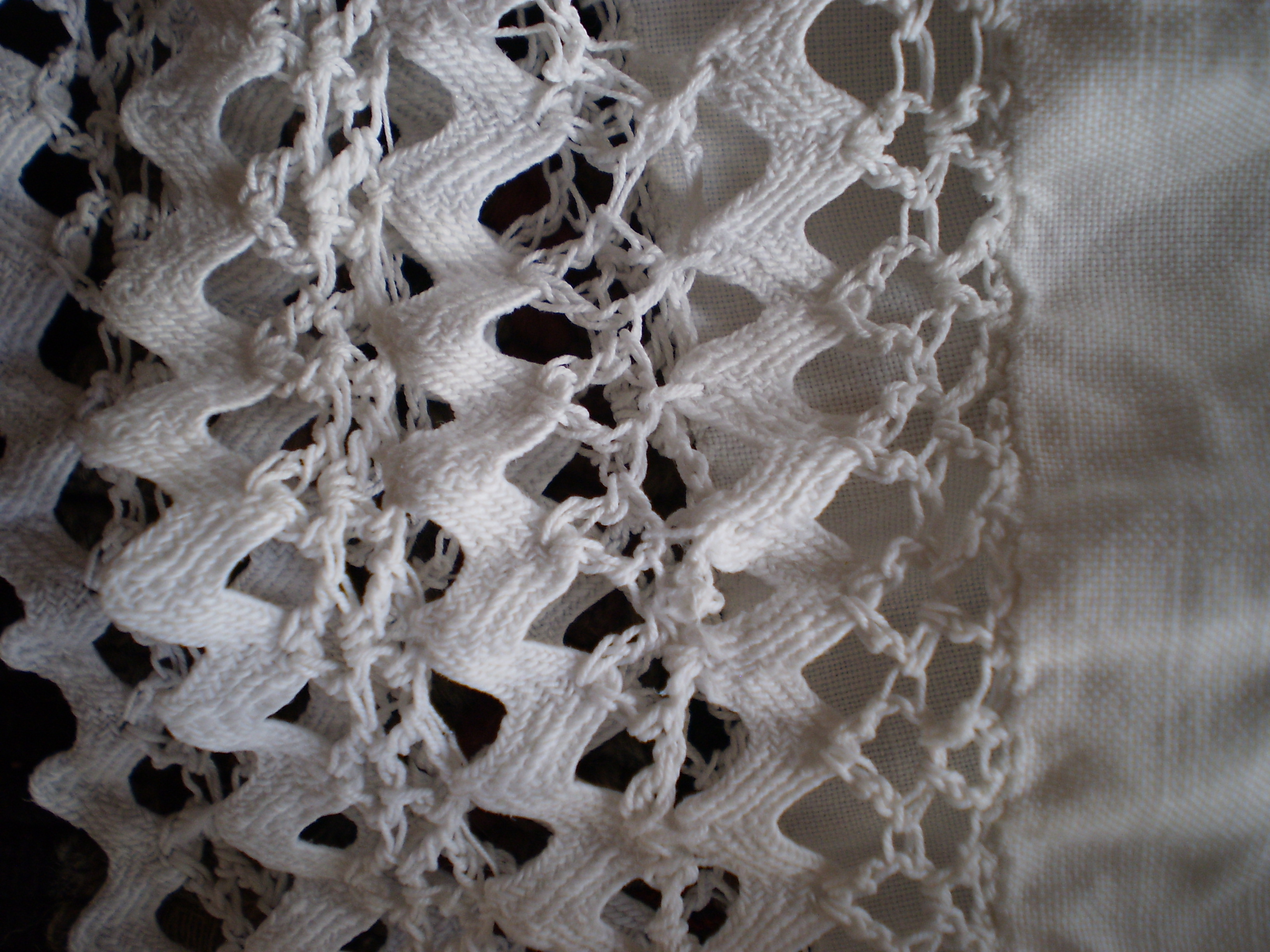
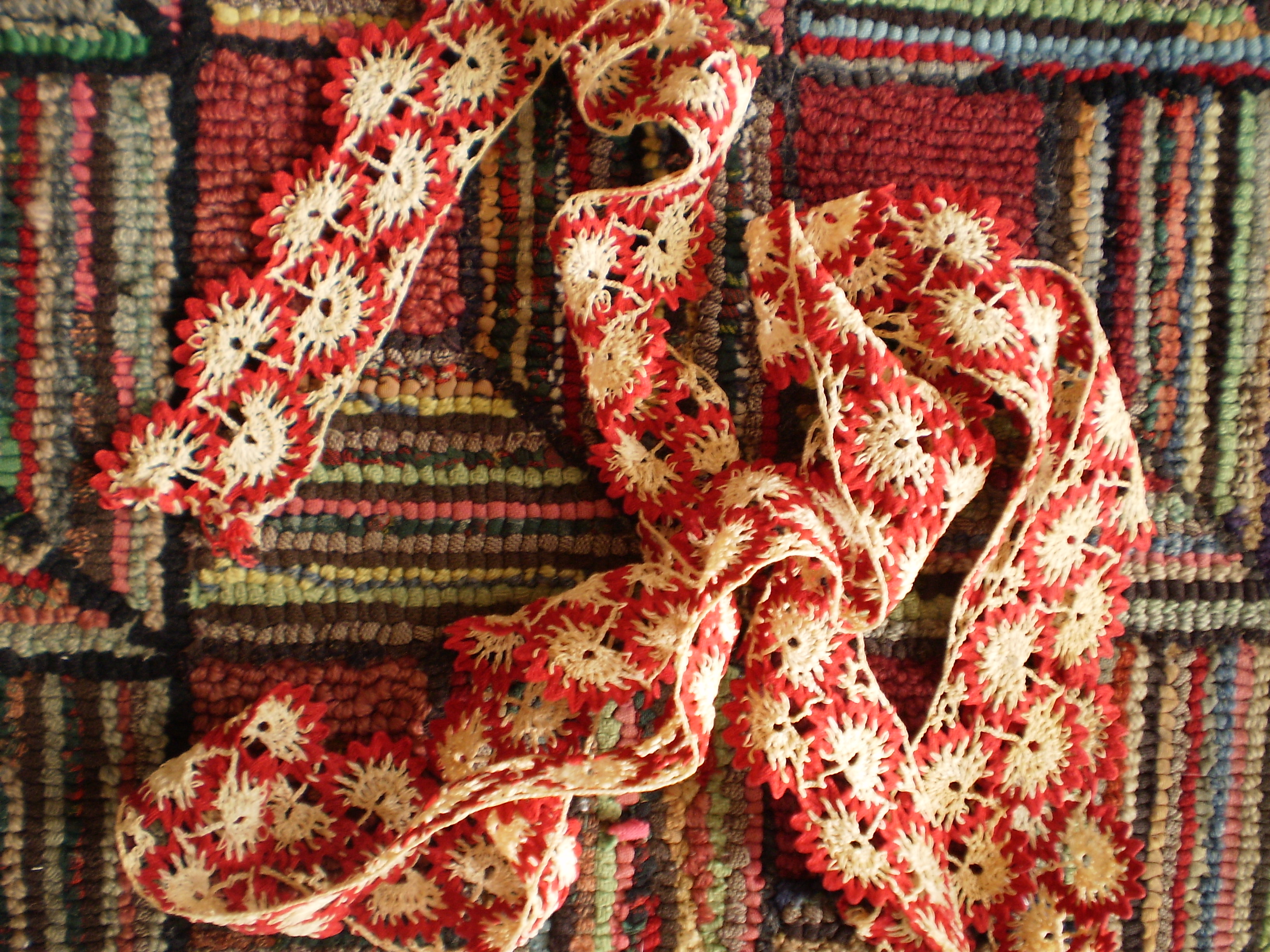
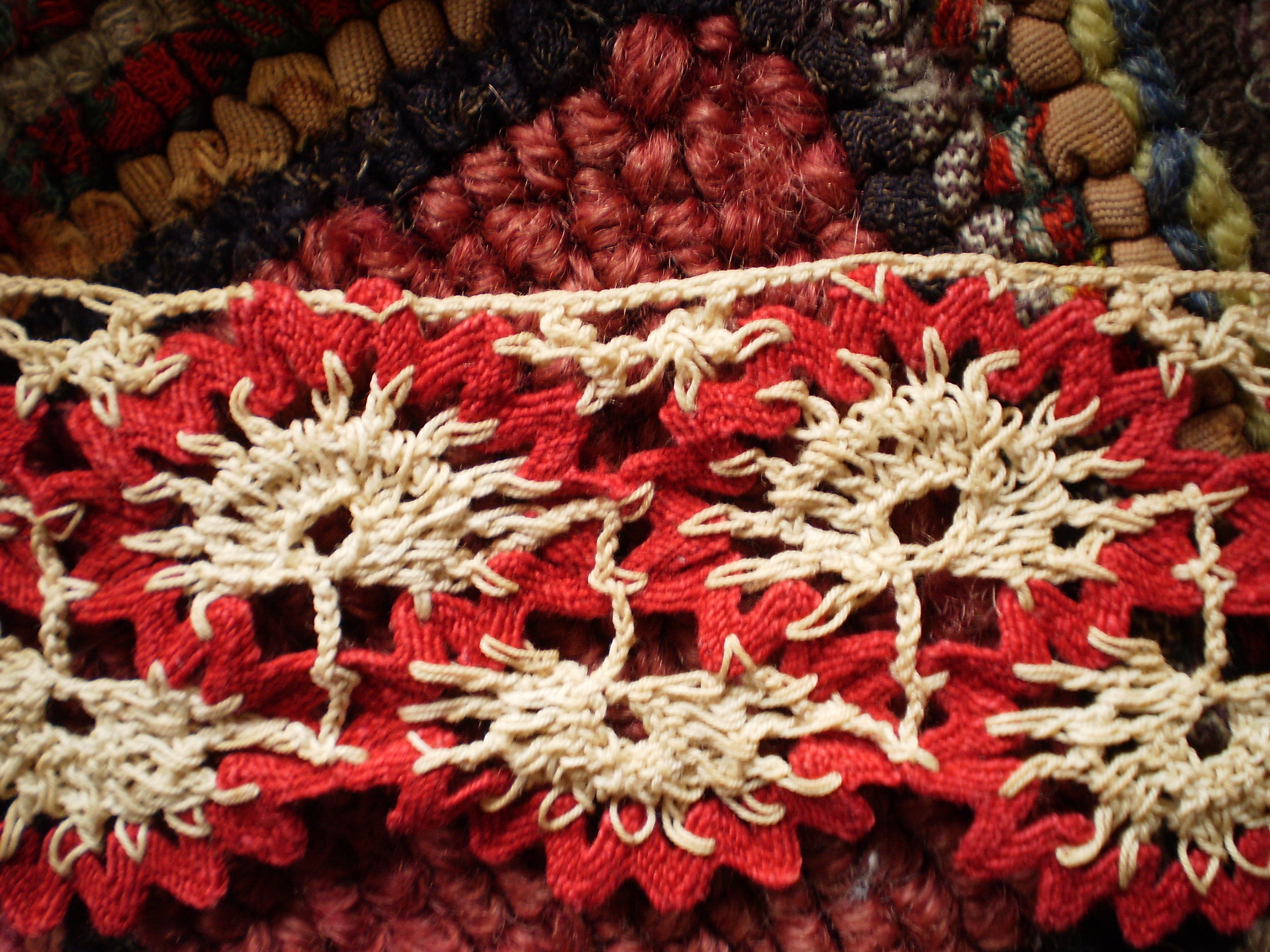
This is the lower edge of a doll's petticoat, from my collection, that is trimmed with tucks and an extravagant use of waved braid.Having the patience and perseverance to hand stitch the points of waved braid together, with a single thread, is rewarded by the spectacular effect you can achieve for very little money.A close-up of white lace created by combining crochet with waved braid.The use of colored braid with crochet gives an entirely different effect to this antique lace.This waved braid lace is destined to grace the petticoat of one of my Izannah Walker dolls. It will look just perfect peeping out from below Turkey red skirts!
No matter what name you call it by, waved braid, snake braid, corrugated braid, rick rack ( alternately ricrac, ric-rack or ric rac) is a very authentic choice for trimming historically accurate, mid-1800’s reproduction doll clothing.
Izannah Walker was born 194 years ago today on September 25, 1817. Happy Birthday Izannah! To commemorate the occasion I’ve created a special Izannah Birthday Doll with an outstanding eleven-piece wardrobe. I’m also having a birthday sale, from today 9/25/11 through next Sunday 10/2/11, all reproduction Izannah Walker dolls, Izannah Walker Doll Making Classes, Izannah Walker Doll Clothes Patterns and Spun Cotton Ornament Classes are 10% off. This sale includes custom order dolls and as always you are welcome to place items on lay-away. If you have any questions, want to place an order, or would just like to chat about Izannah and her dolls and mine, I can be reached at 860-355-5709 or paula@asweetremembrance.com.
Izannah Birthday Doll
SOLD - Birthday doll and her wardrobe.
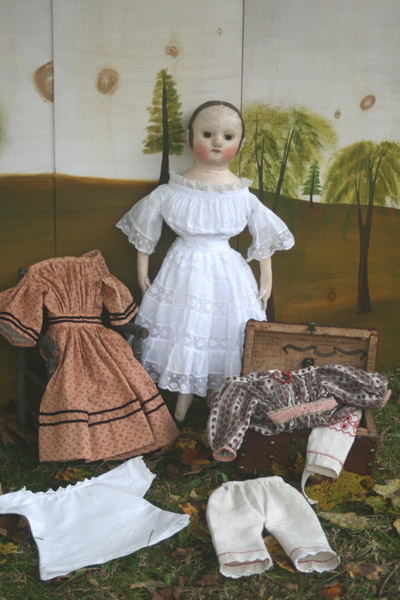
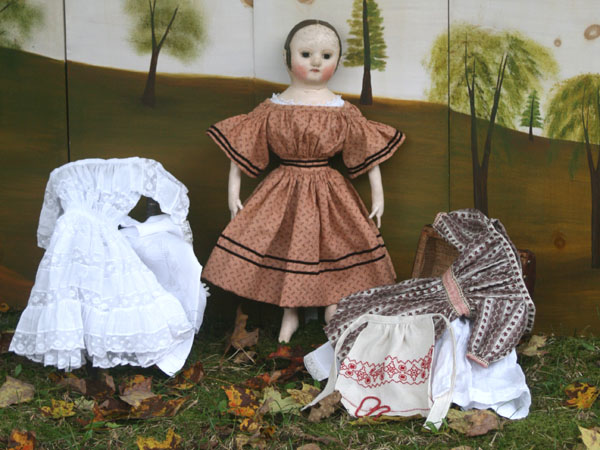
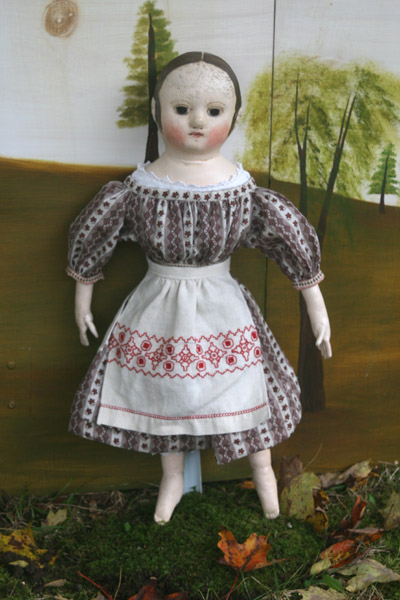
Even though I was rushing to beat the rain and falling darkness, I had the best time yesterday taking photos of this doll. It was great fun to “play dress up” with her. Her extensive wardrobe includes three dresses, two chemises, two pairs of pantalettes, two petticoats, an apron and a real coral bead necklace. If you’d like to add more pieces to her wardrobe I can make her hand made leather shoes, a cotton sunbonnet and a straw bonnet.
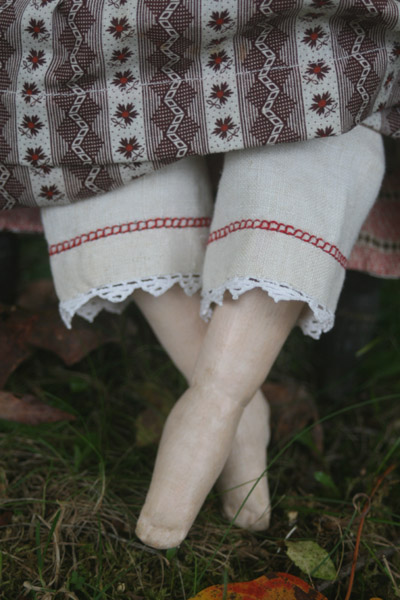
SOLD - This dress has wonderful sleeves, notice the rows of gathers at the top of the sleeve by the shoulder line.SOLD - This view shows the yards of 1/8th inch velvet ribbon encircling the sleeves, skirt and waistband.SOLD - The fabric for this dress is a very old 24 inch wide pumpkin orange on white print with small brown leaves and red berry dots.SOLD - Here she is wearing her brown and red dress, which is made from another fantastic early fabric.SOLD - She comes with a real coral necklace, which matches the Turkey red embroidery on her linen apron.SOLD - This view shows her tiny stitched toes peeping out from beneath her pantalettes. The pantalettes have Turkey red embroidery to match her apron and crocheted lace in a triangle pattern that echos the zig-zag stripes in her dress fabric. Look at the coordinating fabric lining the "false hem" of her dress.SOLD - She's all dressed for a party in this sheer cotton dress embellished with row upon row of lace insertion.SOLD - Two long ringlets curl in front of each of her ears. Thank you for looking!
To read more about, or purchase this doll please visit my website A Sweet Remembrance. I’d be happy to answer any questions you may have or provide additional photos, just ask 🙂 860-355-5709 paula@asweetremembrance.com.
Make a Wish
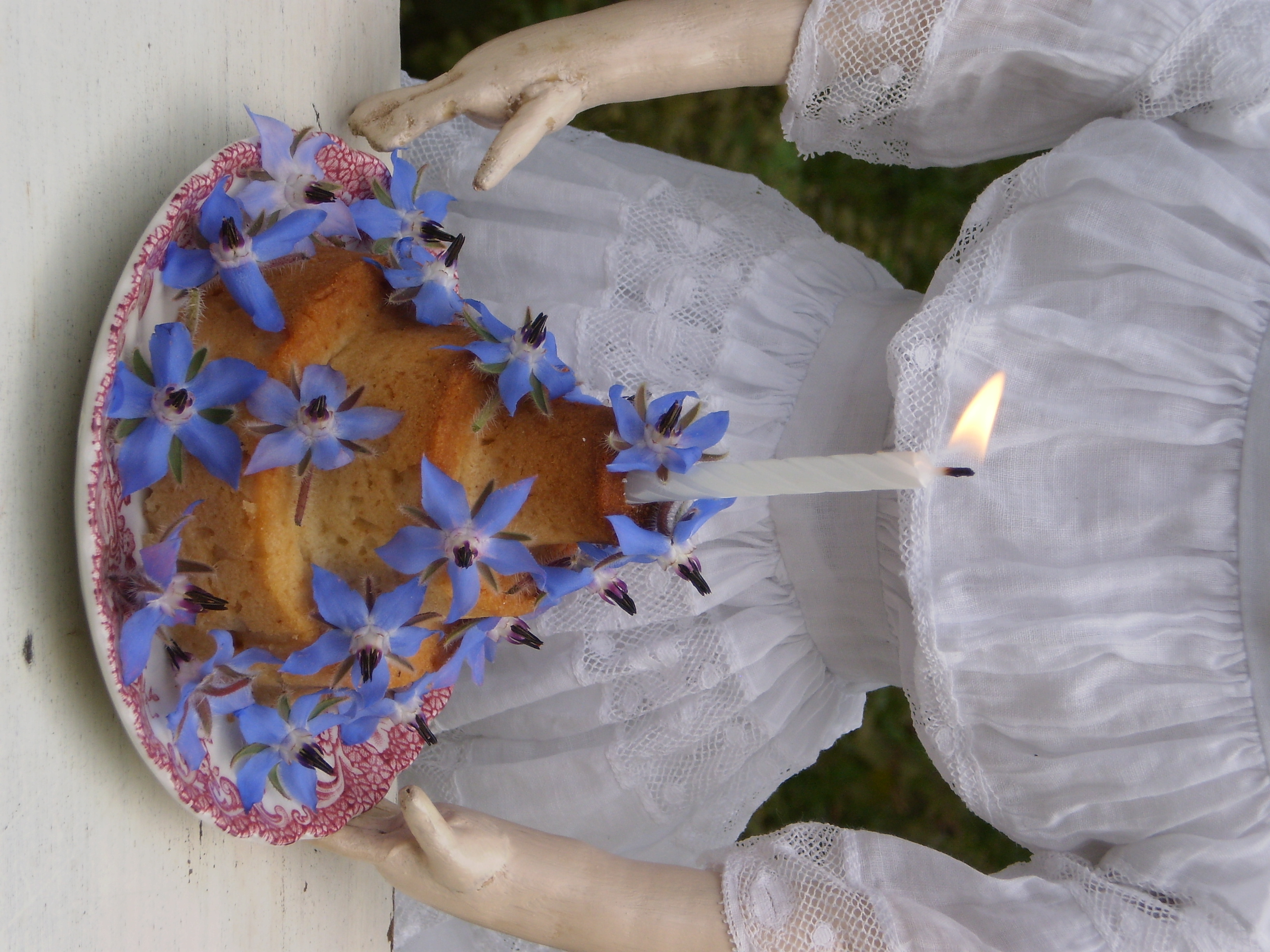
Birthday pound cake decorated with fresh borage flowers.
This year the girls and I baked a pound cake for Izannah’s birthday using a c.1754 receipt that I found in The Williamsburg Art of Cookery. This receipt is old enough to have been a well loved family favorite by the time Izannah was born. Here’s the recipe so that you can bake one too.
Pound Cake
Beat one Cup of Butter to a Cream, slowly beat in one and one third Cups of Sugar. Add one Teaspoonful of Mace and beat in five whole Eggs, adding them one at a time. Sift in two Cups of Flour, turn at once into a greased and floured Pan or Mould and bake slowly for one Hour.*
*I baked my cakes in a 300 degree oven, 30 minutes for the doll size cakes and two hours for the larger version.
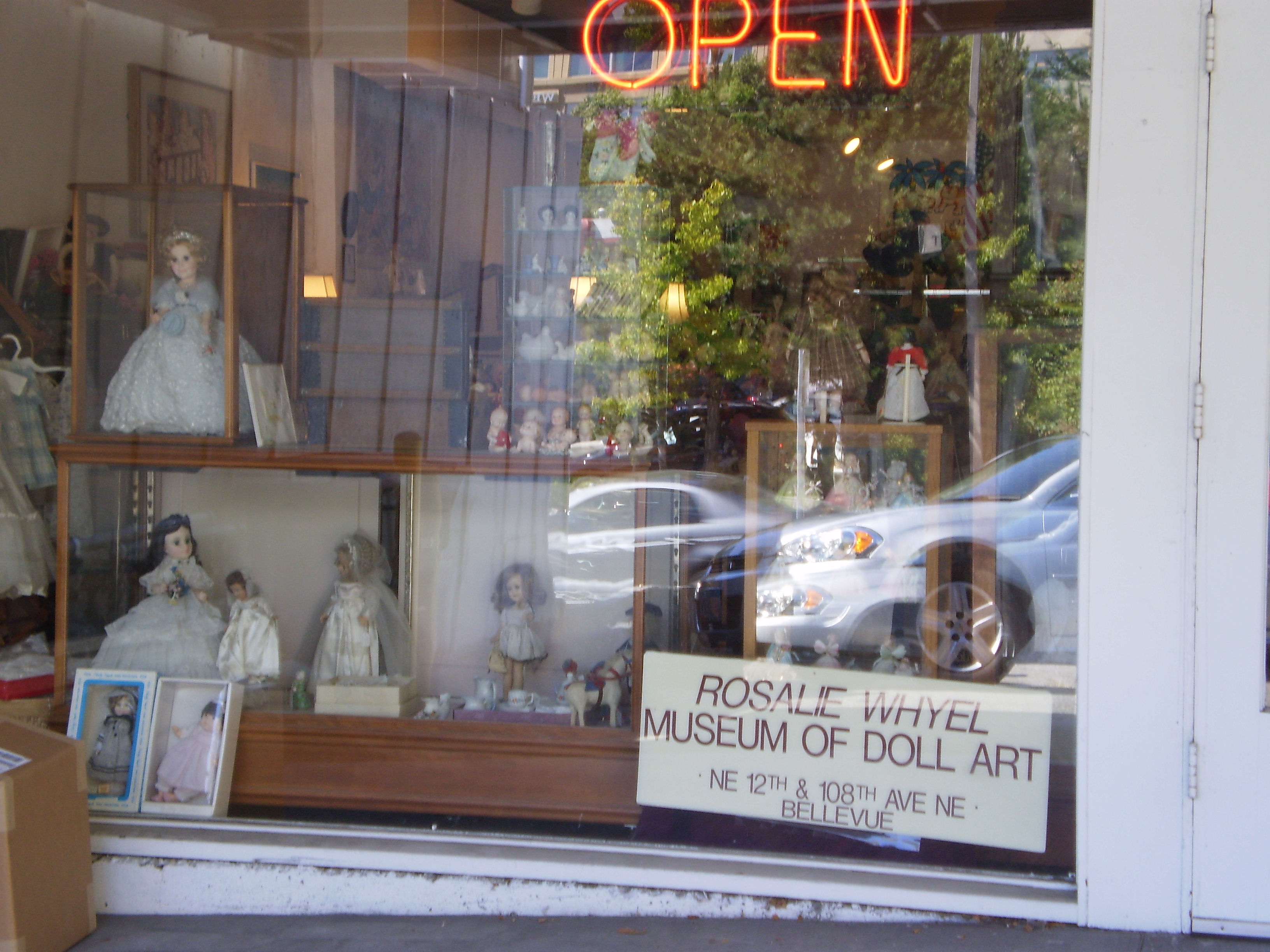
Last month, while in Kirkland, WA for a family wedding, I had the chance to visit the Rosalie Whyel Museum in neighboring Bellevue. Sadly the museum will be closing in a few months on March 1st, 2012.
If you can get to the museum before it closes, do so! The collection is wonderful. The highlights for me are the two Izannah Walker dolls, a lovely pre-patent doll dressed in red wool challis, with a trunkful of belongings and a tiny 13 inch patented doll with the molded shoulder-plate. The wooden dolls are also amazing, especially one 24 inch George II era English wooden from 1750-1760 with a large original wardrobe of superbly sewn garments.
The day following our museum tour we headed over to Rosie’s Too , which is a second, off site, collectible doll shop owned by the museum. I found a cute, tiny black bisque baby doll and an antique chemise just the right size for one of my Izannahs.
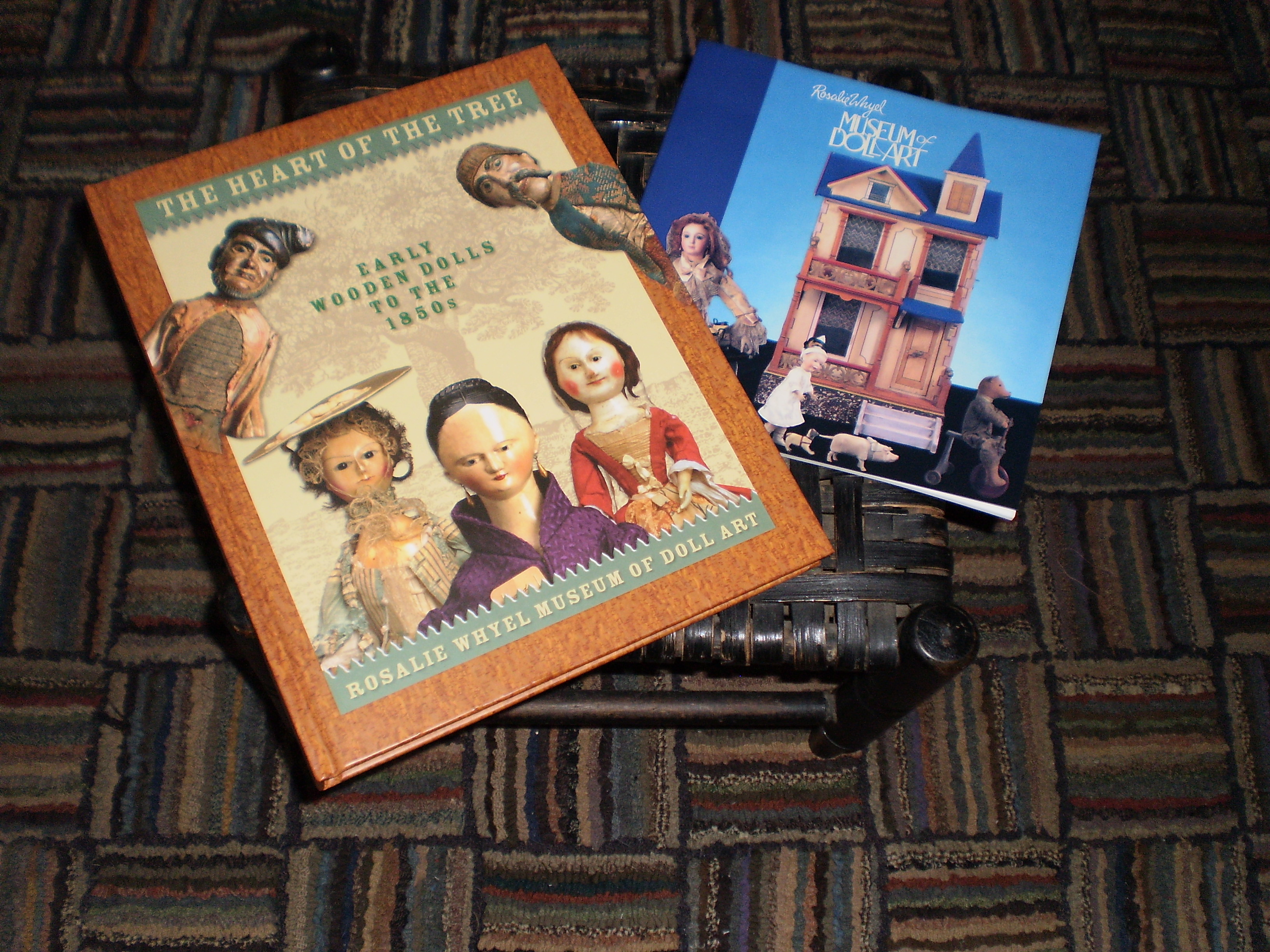
If you can’t visit in person, the museum sells a book entitled The Heart of the Tree, which chronicles their 2002 exhibit of the same name. It’s a lovely book and I didn’t mind paying the $49.95 cover price, but I do wish that it included the fantastic 24 inch 1750-1760 doll that I mentioned above. I had to make do with buying several postcards of her and her wardrobe. They also sell a small paperback souvenir book about the museum called Rosalie Whyel Museum of Doll Art Opening Our Doors to You for $11 or $12, which has a nice photo of their pre-patent Izannah. I did not buy their larger book “THE ROSE UNFOLDS” RARITIES OF THE ROSALIE WHYEL MUSEUM OF DOLL ARTVolume One. It wasn’t so much the $79.95 price tag as it was the size and weight of the book. I just couldn’t face dragging it around Washington, then on to California and finally back to Connecticut 🙂 I may have to break down and purchase it a some point, because it does have large lovely photographs of both of their Izannah Walker dolls.
You can also find photos of both the Rosalie Whyle Izannahs in the article “Izannah Walker – Godmother to Cloth Doll Makers” by Susan Hedrick, Soft Dolls & Animals, Summer 1998 and a photo of just their pre-patent Izannah in “Early American Stockinette Dolls: Part 1- Izannah Walker and Martha Chase Dolls” by Judy Beswick, The Cloth Doll, Fall 1998.
If you would like to read more about the museum there is a nice article on page 14 of the July 2011 issue of Antique Doll Collector.
Many articles have been written about Izannah Walker and her hauntingly beautiful, iconic cloth dolls. I have found all of them extremely interesting and well worth reading. However, it occurred to me that none of the articles that I have seen were written by someone who has actually made full size reproductions of Izannah’s pressed cloth heads and has experienced first hand the joys and frustrations of this unique type of doll making. So I’ve decided to join the ranks of doll lovers and historians who have gone before me in writing about this fascinating woman and her exceptional dolls.
It feels like I have loved Izannah Walker dolls for my entire life, although I know that can’t be true. When I look back, I think that I first became aware of her dolls right around the time that we moved to New England, 22 years ago. I do know that I have loved, and always wanted to own, antique dolls since my very early childhood. As soon as I knew that such things as really old dolls existed, I wanted one (or more!).
Izannah Walker and her dolls hold a very special place in doll history. On November 4, 1873, she was the first woman to receive a United States patent for making dolls.
Izannah Walker was born in Bristol, Rhode Island on the 25th day of September in 1817. I have read there is documentation that she started making dolls in 1828. She would have been 11 years old in 1828, the same age that I was when I first learned to sew. Norma H. Robertson, Izannah Walker’s grand-niece, stated that her great aunt began making stockinette dolls in 1845 for friends, and as her business developed, she put her three sisters to work painting faces. Other research and information that I have seen states that Izannah had two sisters, plus several older half-siblings, and that Izannah, her older sister Jane and her aunt Jane Hintz were all three doll makers.
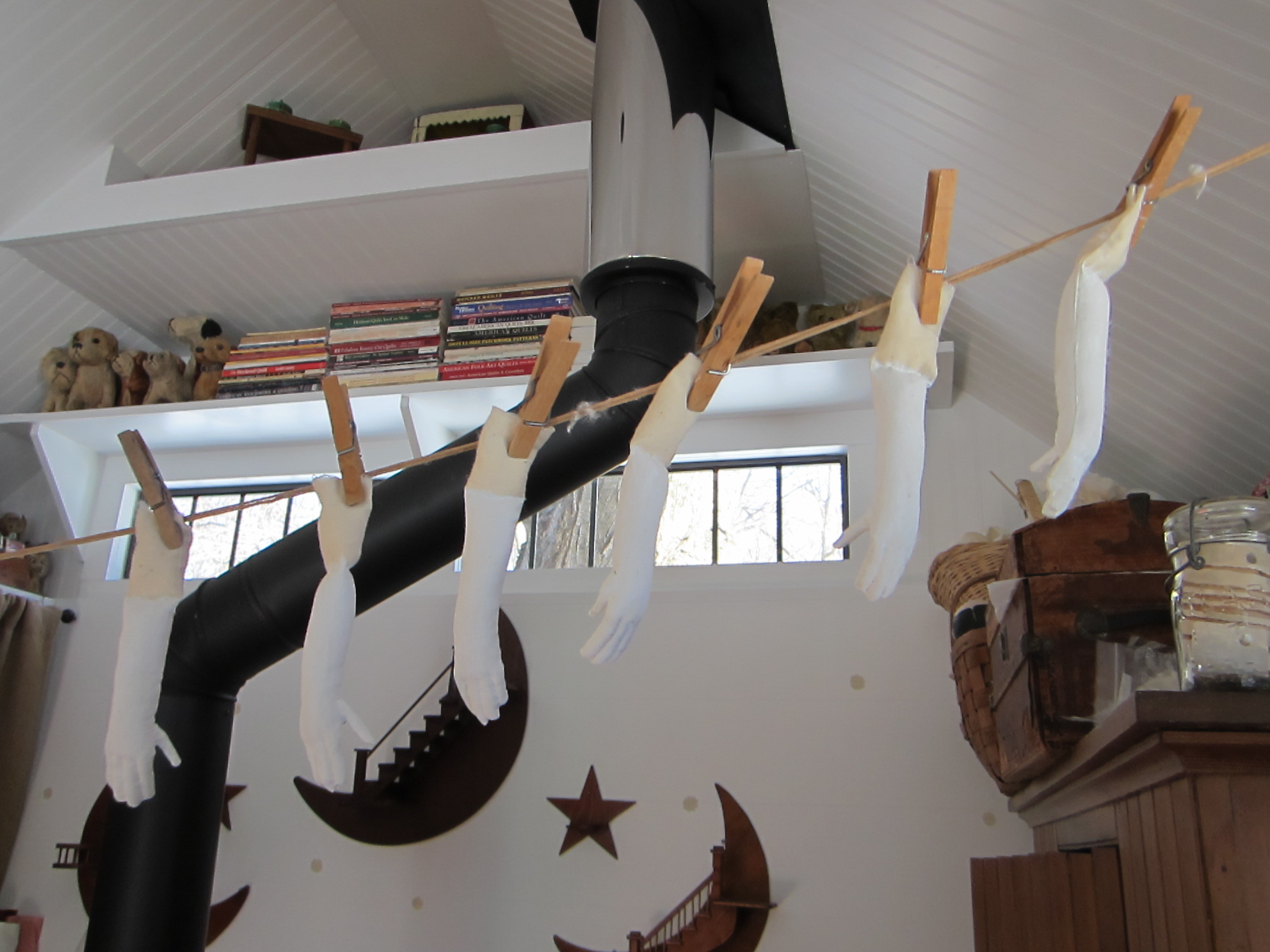
One of my favorite Izannah stories is a reminiscence by Mrs. Helen Pierce of when the Walker sisters were living on Main Street in Somerset Village, MA. Mrs. Pierce tells a tale of the Walkers hanging their dolls out on the clothesline to dry when it was too damp in the house and how the air in the neighborhood was then permeated with the smell of oil paint. I can certainly relate to that, having hung my share of dolls out on the clothesline.
The Mystery of Molds and Lessons Learned About Pressed Cloth Heads
One of the things that I find most endearing about the Walker dolls is their differences. This may be because three individual women had a hand in their construction, either working together or apart. It is also, in my opinion, a very basic fact of life when a doll maker is creating dolls with pressed cloth heads. While all of the original dolls are recognizable as Walker dolls, they do come in many sizes, from 13 to 27 inches* in height, and often have very striking differences from one another. The majority of the dolls are girls, although there are a few boy dolls and even fewer black dolls with lovely, short, nubby black wool hair.
There has been a great deal of speculation in the doll world about the number and origin of the molds Izannah Walker used to make her dolls. I can’t offer any clues about how the molds were made. Did she sculpt her own prototype heads and then have them made into metal molds? Did she hire others to create both the original sculpt and molds? Or did she commission molds from commercially available European dolls? Her patent information shows the use of a metal mold and dye, but did she always use metal molds? Is it possible that her earlier dolls were created using plaster molds, which were long established in the doll making industry at that time, and would wear out and need replacing more frequently?
Example #1 of dolls with pressed cloth heads made from the same mold.Example #2Example #3Example # 4Example #5Example #6 Notice how much rounder and fuller the cheeks are on this doll.
What I can say with some confidence is that it is very likely that she used fewer molds than many people think. Obviously, she had to have a variety of molds for the different sized dolls that she made and it is equally obvious that her early dolls used very different molds than her later, patented dolls. What I have found when making pressed cloth heads is that heads made using the same mold will turn out quite differently from one another. When making pressed cloth heads, you do not get the same consistency as you do when casting materials, such as bisque, papier-mâché and wax, that can be poured into a mold and hardened. Izannah’s pressed cloth heads were made in sections that had to be joined together, a process that sometimes causes individual heads to come out a bit larger or smaller than each other. After the front and back sections of the head were sewn and or glued together, the head was stuffed with cotton, horsehair, sea grass or other materials. The pressed cloth heads are not rigid like the heads of a china or porcelain doll. They are somewhat flexible and their shape can be altered by how tightly the stuffing is packed into the head. All of these factors can and will change the appearance of the finished pressed cloth head.
Photo taken with Canon Digital RebelPhoto taken with Olympus Digital FE-20 camera
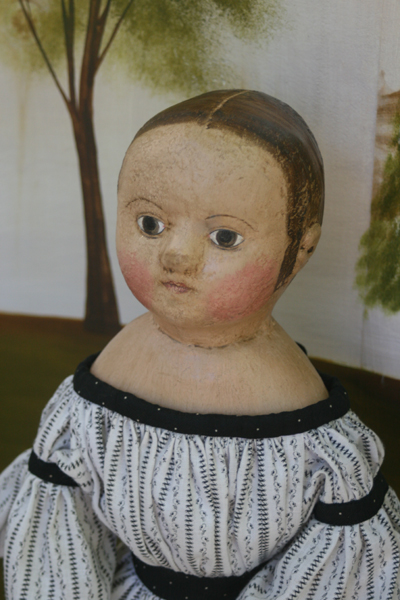
Another point that I would like to mention here is that when studying photographs of Izannah Walker dolls, it is important to remember that the photographs do not always look the same as the doll does in person. I am by no means a professional photographer, but I am a person who takes an inordinate number of doll photos, using several different cameras and lenses. The type of lens used to take a photograph will have a big impact on how the doll looks, as will the lighting and angle from which the photo is taken. People who have only seen Izannah Walker dolls in photographs are often very surprised when they first see one of the dolls in person. The dolls are smaller and much more delicately proportioned than they often look in photos. Their eyes are not as large and their foreheads aren’t quite as curved and pronounced as people expect. I am fortunate enough to have been able to visit several museums and view dolls in person that I had previously only seen in photos and I can attest that there is a real difference. I see this same difference when I photograph both my antique Izannah Walker dolls and the reproductions of them that I make. So some Walker dolls may look more similar in person than they do when compared in photographs. Especially when they are photographs taken by different people, using different cameras, lighting, etc.
Photo taken with an Olympus FE-20 digital cameraPhoto taken with a digital Canon Rebel camera
The painting style is another variable from doll to doll. Again, this may be due to more than one person wielding her brush, or it may be because when a doll maker paints a doll, each one is slightly different from the next. Even if you have never made a doll in your life, I’m sure that you can relate. Think about your signature. It is something you do over and over again. Is it exactly the same every time? When you make your favorite recipe, the one you know by heart and don’t have to look up, does it turn out just the same every time? Izannah Walker’s dolls were made over a long period of time. Even if a single person painted them all, it is natural that they would change. When I paint my dolls, the colors will vary a bit since I don’t use a “recipe” to mix my paints. Some days, I paint finer lines than others, paint better curls, make more blushing cheeks and crisper bootlaces. Such is the nature of hand made artistry and it is why Izannah Walker dolls are so well loved and enduring. The hand of the doll maker shows in each and every one of them. They are similar and yet individual works of artistry.
I like to think that the women all worked together, even when they were separated by distance (which they were during different periods in their lives). My sister and I make reproduction samplers together, even though she lives in Nebraska and I live in Connecticut. Both of us work on every sampler that we make, each doing our own part to create the final product. It would have been possible for the Walker sisters and their aunt to do the same, and I hope that they did. My sister and I enjoy working together and I’d like for the Walkers to have had the bond that shared goals and joint work brings about.
Construction Features of the Walker Dolls
Like any other reproduction-sewing project, making an Izannah Walker doll is an eye opening experience to the difference between 19th century and 21st century sewing construction. People in the 1800’s obviously viewed pattern making and sewing construction differently than we do today. The shapes of many of the pattern pieces used to make these dolls and their clothing are unfamiliar to modern seamstresses.
Izannah’s earliest dolls had heads that were made of molded and pressed cloth joined to the bodies at the neck. This is different than the later patented dolls that had molded and pressed cloth heads and shoulder plates that were glued onto the bodies. I think the early dolls are prettier than their later sisters, and they are the type of Izannah Walker dolls that I prefer to reproduce. The front of the pre-patent doll’s head is joined to the back just in front of the ears. The back of the head has a partial center seam.
Often you will see that the dolls have repaired ankles. This is because they have a seam at the ankles that connects the foot to the leg. Modern cloth dolls are seldom made this way. The dolls have narrow waists, with wide shoulders and hips. The unpainted portions of their bodies are covered with a “second skin,” which gives them a neat, finished appearance, and points to the care with which they were made.
I find all of these details intriguing. They are part of what draws me to study Izannah Walker’s dolls and have kept my interest in them so strong for many years.
Izannah Walker dolls were made using molds. That does not mean that they took less work or are less desirable than a doll that has a one-of-a-kind sculpted face. For me, understanding how the Walkers made their dolls and using those same techniques to make dolls of my own gives me an even deeper love and appreciation for the originals. Through years of experience, I know exactly why some of the dolls have that characteristic crease at the hollow of their throat, why the paint on the earliest dolls cracked and peeled, why the hands have such a wonderful shape and how to make that slight curve at the wrist. I treasure the experience, the knowledge and the insight and I would urge you to try your hand at making a doll using Izannah’s methods. It will give you a wonderful glimpse into her world and her art.
Collection of the author
Izannah Walker managed to capture an evocative moment of American history and very firmly convey a sense of her time and place in a child’s toy. These toys continue to be treasured, loved and marveled at today.
* There are rumors of a “life-size” doll that was owned by members of the Walker family.
Sources for some of the information used in this article and additional reading:
American Folk Dolls by Wendy Lavitt (Knopf 1982)
American Rag Dolls Straight From The Heart by Estelle Patino (Collector Books 1988)
“An American Master of Cloth” by Helen Nolan, Dolls, February 1995 (this article is about Martha Chase and only has a brief mention of Izannah Walker)
“The Art of Dolls 1700-1940” by Madeline Osborne Merrill, Doll Reader, April 1985
Cover Photo by Dorothy McGonagle, Doll News, 1989
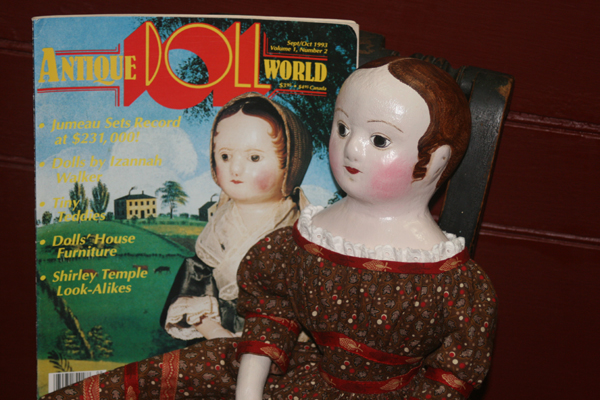
“Dolls by Izannah Walker” by Donna C. Kaonis, Antique Doll World, September/October 1993
The Doll Collection of Helen Gage, Auction Catalogue by Marvin Cohen Auctions, December 1984
“Dolls of Rhode Island” by Carolyn Guise, Two Hundred Years of American Dolls, The New London Doll Club United Federation of Doll Clubs Region Fourteen Meeting, May 1977
Early American Dolls in Full Color, by Helen Nolan (Dover Publications 1986)
“Early American Stockinette Dolls: Part 1- Izannah Walker and Martha Chase Dolls” by Judy Beswick, The Cloth Doll, Fall 1998
Encyclopedia American Dolls by Ruth S. Freeman (Century House 1952)
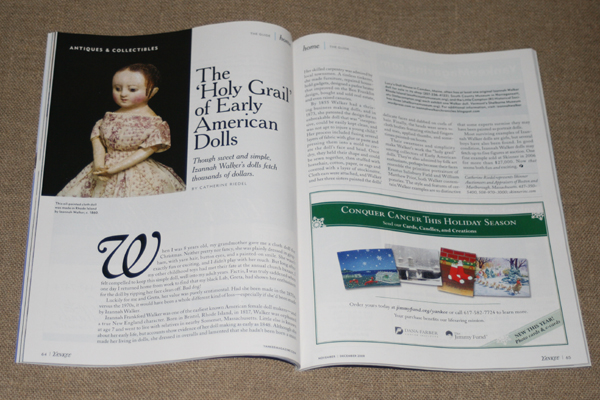
“The “Holy Grail” of Early American Dolls” by Catherine Riedel, Yankee magazine, November/December 2009
“Izannah Walker – Godmother to Cloth Doll Makers” by Susan Hedrick, Soft Dolls & Animals, Summer 1998
“Izannah Walker’s Iconic Dolls” by Edyth O’Neill and Dixie Redmond, Early American Life, Christmas 2011
“An Izannah Walker Reunion” by Carol Corson, Antique Doll Collector, August 2011
“Izannah Walker: The Mystery Deepens” by Helen Nolan, Dolls, August 1994
“The Little Doll With The Little Curl” by Maurine S. Popp, The Jenny Lind Doll Club of Southern Connecticut Region 14 of The United Federation of Doll Clubs, April 1968
Made to Play House: Dolls and the Commercialization of American Girlhood, by Miriam Formanek-Brunell (Johns Hopkins University Press, 1998)
“The Mystery of Izannah Walker” by Helen Nolan, Dolls, September 1993
“The Search for Izannah Walker” by Monica Bessette, Doll News, Spring 1994
“Stitches in Time” by Diane Goff, Doll Reader, July 1993
Summer in Marseilles at the Turn of the Century Auction Catalogue by Theriault’s 1993
“They’re Just Down-Home Folk” by Wendy Lavitt, Dolls, May 1993
The Treasury of Beautiful Dolls, by John Noble (Weathervane Books, 1978)
“Walker Dolls: A Family Affair” by Monica Bessette, Doll News, Summer 1998
This article and the accompanying images, like all posts and photographs on this site, are copyrighted by Paula Walton and may not be published or reproduced in any form without the express written consent of the author.
If you would like to purchase this doll, please visit my website A Sweet Remembrance, or simply call (860-355-5708) or email (paula@asweetremembrance.com) me.
Here she is in her pantalettes and chemise.
Her petticoat is an antique that I cleaned and altered to fit her.She is wearing a simple white dress with a tucked skirt and sleeves.Over her dress she wears a lace trimmed apronIn good company with her much older sisters (my original antique Izannah Walker dolls).
I’m sure that you can all call to mind an image of a classic Izannah Walker doll, wearing a charming print dress with a neckline that gently hugs her shoulders. Layered under her dress will be a chemise, petticoats and pantalettes.
When you are dressing your Izannah Walker doll it is important for her undergarments to have the proper fit. If your doll will be wearing a low cut dress then her chemise must be cut to match.
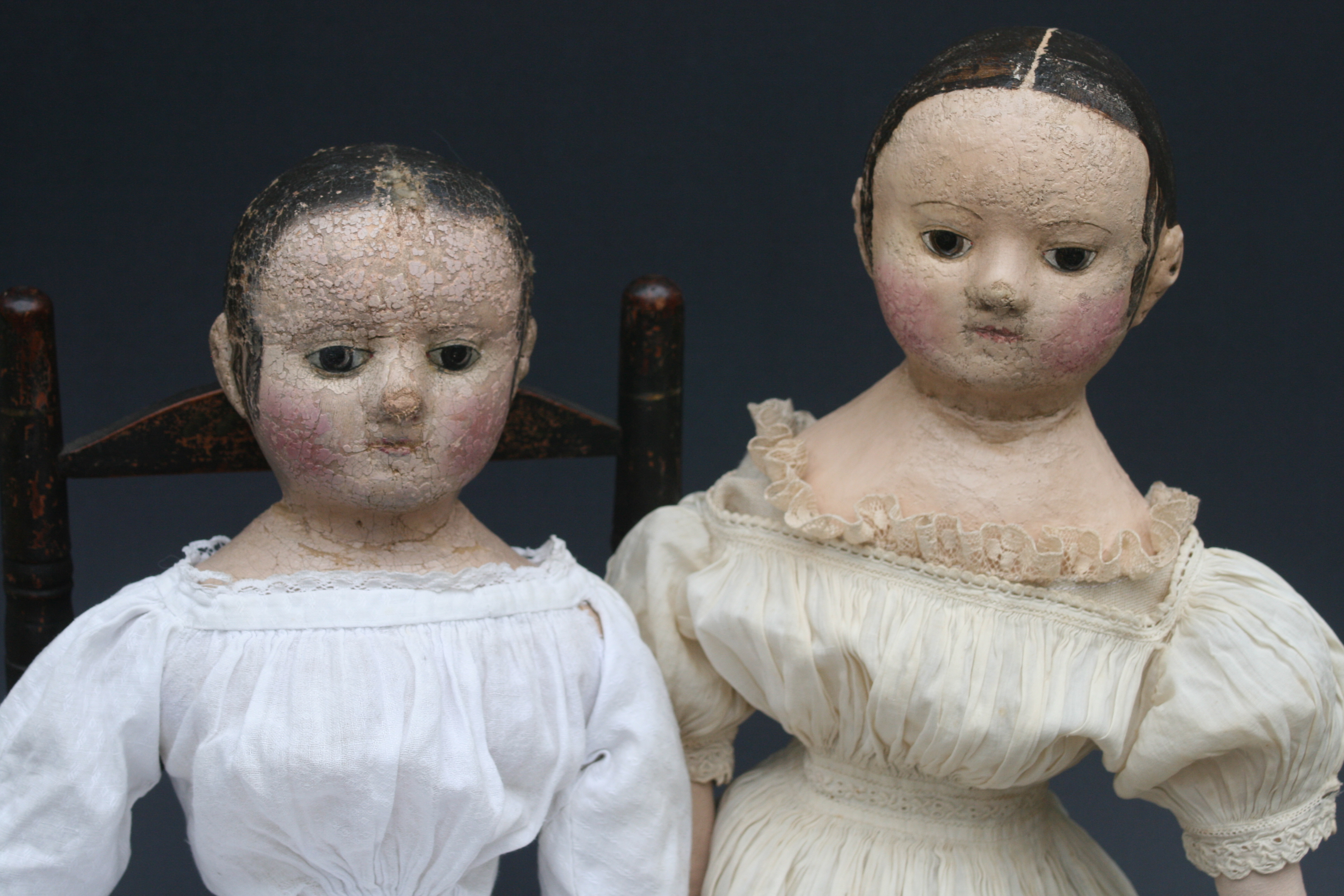
It has been speculated that Izannah Walker was making dolls as early as the mid 1840’s. Low shoulder baring gowns were fashionable for young children beginning in the late 18th century through the mid 1860’s. After the Civil War necklines on children’s dresses and chemises rose. The doll shown on the left, in the photo above, wears her original chemise that shows all of her shoulders, right up to the top of her arms. The hem line of this chemise falls below her knees. The doll on the right also wears her original chemise, but it’s neckline and hemline are both higher, with the bottom of the garment ending just below her hips (click here for another view). Both chemises are made of cotton sheeting.
The fit of the doll’s chemises are very true to life and match the fit of corresponding real chemises of the period.
c. 1860 calf length, machine stitched, cotton sheeting chemise with Turkey red embroidered eyelet and a single inital.
A chemise is the garment that was worn closest to the body. Stays/corsets were worn over the top of the chemise, followed by petticoats. Pantalettes, once they were introduced in the early 19th century, were worn under the chemise to cover the legs. If a chemise fits properly, even though the neckline is off the shoulder, it will easily stay in place without falling off.
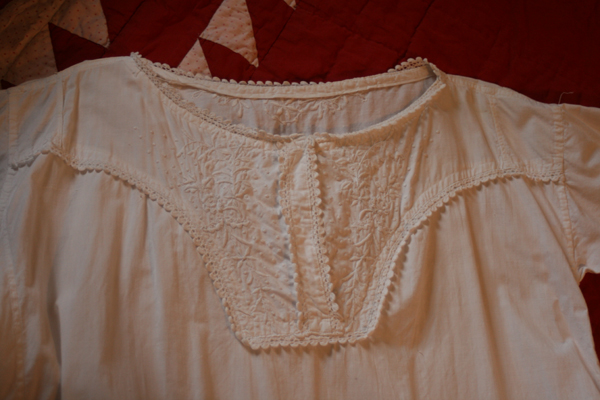
Machine stitched cotton sheeting chemise with fantastic hand embroidered yoke and sleeve trim.Close up view of embroidered detail.Machine stitched linen chemise with tatted lace trim and red embroidered initals and number. Chemises, men's shirts and sheets were often embroidered with initals and numbered, to make sure that they were rotated evenly.Sleeve and gusset detail.Machine stitched cotton sheeting chemise with hand embroidered yoke and crochet lace.
If you would like a closer look at any of the small photos, you can enlarge them by clicking on the image.
























 Izannah Walker Journal