Other Types of Doll Making

Moravian Style Cloth Doll Class

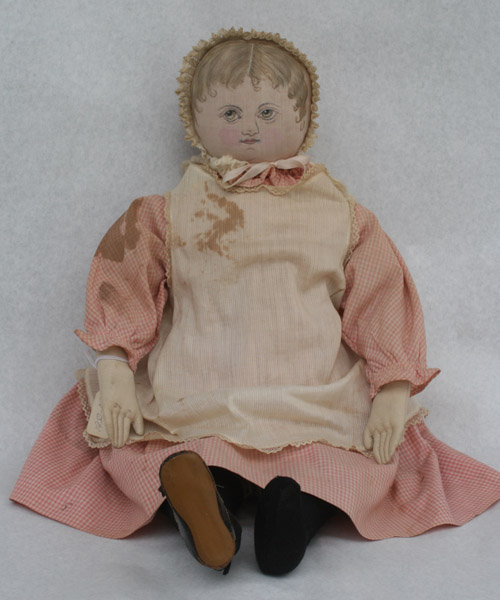
Moravian Church Doll 500As I’ve mentioned previously, the museum that I’m the Director/Curator of has a Moravian cloth doll in it’s collection.  In December I’ll be teaching a class at the museum on how to make a doll like the one owned by the museum.  While it isn’t an Izannah type of doll, I thought some of you might still be interested in taking the class anyway.   It’s a charming, well made cloth doll that has of lot of very nice details.

Moravian Style Cloth Doll.  December 12, 2009 10:00-4:00

Come join us for a creative, informative day of sewing.  Learn to make a cloth doll in the style made by the Sewing Circle of the Moravian Church.  The pattern for the doll that students will be making in this class is based on the Moravian Rag Doll (1950-18) that has long been a resident in the Knapp House “Toy Room”.  This cloth doll has painted features and is traditionally dressed in either pink or blue gingham.  Participants in this class must know the basics of machine sewing.  A list of materials and equipment to bring along with you will be sent upon receipt of your registration.  Tuition includes the doll pattern and a printed cloth face (either for reference or for you to use instead of painting).

Tuition: $80 for members, $89 for non-members.

The Class is being held at the museum, 6 Aspetuck Avenue, New Milford, CT.  A minimum registration of four students is necessary for the class to be held.

Moravian Doll Close Up 600Registration Form

Name___________________________________________________________________

Address_________________________________________________________________

________________________________________________________________________

Telephone Number______________________________________________________

Email___________________________________________________________________

Class___________________________________________________________________

Check enclosed for $___________________

Please fill out and return along with your payment to

The New Milford Historical Society

P.O. Box 359

New Milford, CT  06776-0359.

Antique Izannah Walker Dolls · Stray Comments

Happy Easter!

The Izannahs and I would like to share a few photos with you from our Easter celebration yesterday.  We hope that you spent the day in the company of your nearest and dearest and that it was a glorious day for all.

Click on photos to enlarge.

Stray Comments

My New Job

As of two weeks ago, I have a new job. I am now the director and curator of the New Milford, Connecticut Historical Society Museum. I will still be running my business, A Sweet Remembrance. The only difference will be that I am working at the museum on Tuesdays, Wednesdays and Thursday mornings.

The museum has a very nice doll collection, although only one of the dolls is cloth. It is a Moravian Polly Heckewelder doll. Other collections you might find of interest are the extensive costume and quilt holdings.

If you are in the area and have time to visit, the museum is open on Thursday, Friday and Sunday from 1:00 – 4:00 p.m., starting the last week in April through September. The first exhibit of the season this year is on Abraham Lincoln, in honor of his 200th birthday.

Antique Izannah Walker Dolls · Reference Materials

Sources for Photographs of Antique Izannah Walker Dolls

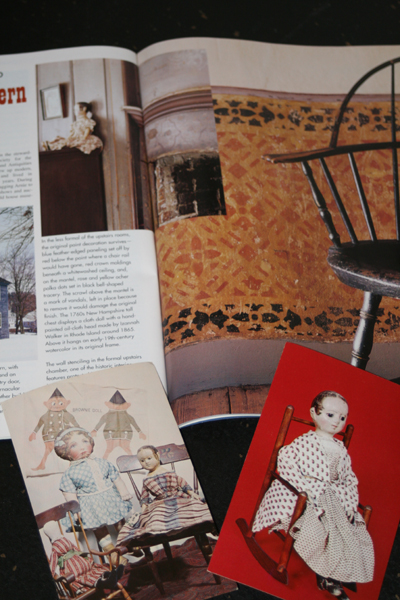
magazine-photosThis is a resource list of photographs in magazines, books and on post cards. The entries listed here are for photographs only, with just an accompanying caption. Actual magazine articles and books that also have photographs are going to be listed under a separate heading. I plan to make this an ongoing list that I will add to as I run across photographs in my huge stash of Izannah resources (I’ve been saving Izannah information for years and years, not necessarily in an organized manner).

Early American Life Magazine, December 2001, page30.

Wenham Historical Association and Museum, Inc., Wenham, MA 01984, postcard.

Mary Merritt’s Doll Museum, Douglassville, PA, postcard.

Better Homes and Gardens Holiday Decorating, 1999, page 45.  This is a wonderful photograph that shows an Izannah Walker doll plus eight other painted cloth dolls, two papier-mache dolls and a whole Christmas tree full of wooden peg dolls (penny wooden).

Stray Comments

Belated Valentine

valentine-front4I hope all of you had a very sweet Valentine’s Day. Brian and I drove to Riverton, CT on Friday the 13th. Riverton is a very tiny town that was the former home of the Hitchcock Chair Company. We had huge, delicious sandwiches and pots of tea for lunch at the Catnip Mouse, and on the way home we went to Buggy Whip Antiques in Southfield, MA. I bought this Valentine along with a handful of others and a purple Staffordshire transferware sugar bowl there at the multi-dealer shop.

Even though I’m running two weeks behind in getting this posted, this Valentine is just too perfect and it would be a shame not to share it with all of you who sew. So Happy Valentine’s Day, a little late!

valentine-back

Doll Clothing · Painted Cloth Doll Making · Stray Comments

Copyrights and Ethics

I am quite fond of antique hooked and shirred rugs. I enjoy working on rugs because it is a very peaceful occupation. Although to be honest, the thing I like best about rug hooking is that it gives me a great reason to dye wool.

Last night I was reading a book that one of my sons gave me for Christmas, entitled Creating an Antique Look in Hand-Hooked Rugs by Cynthia Smesny Norwood, ISBN 978-1-881982-59-3. It’s an excellent book that I highly recommend. As I was reading, I was reminded again how very scrupulous rug hooking books and magazines (in particular Rug Hooking Magazine) are about copyrights.

Cynthia Norwood has written a very detailed, yet clear and easy to understand definition of what copyrights are and how they pertain to you as a craftsperson, whether you sell your work or not. She also discusses copyrights as they apply to antiques. Page 17 of Creating an Antique Look in Hand-Hooked Rugs should be required reading for any and everyone who creates any type of art or craft.

By now, I’m sure that you will have noticed that I am very careful to only sell patterns and finished dolls that are based on antiques that I own, or my original designs. This keeps me out of the murky waters of possible copyright infringement. Even though antiques no longer have copyright protection, you should give credit to the original artisan. Also be aware that the current owners of the antique item do have rights as well.

Speaking of antique reproductions, another thing I should mention is that you need to sign and date your work. Obviously it would be a miracle if we were able to perfectly recreate an antique doll or antique doll clothing. Knowledgeable collectors are going to be able to immediately tell the difference between a newly made doll and a genuine antique. Even so, you want to make sure that you very clearly mark your work. People that do not know as much about antiques could be deceived, especially if your work should ever be sold on the secondary market.  The more hands an item passes through, the more chance there is that information concerning it will be garbled or lost.   Remember what happened when you played “Telephone” as a kid?

My husband Brian and I run into this all the time with antique carousel horses. We find reproduction horses that are being sold by people who honestly believe that they are antiques, due to their inexperience in the field.

Doll Clothing · Where to Shop

Selecting the Appropriate Fabric for Your Doll’s Dress

izannah-and-dressI’m going to admit right up front that seeing an Izannah Walker style reproduction doll, or worse still, a re-dressed antique Izannah, wearing a dress made of fabric that does not fit the style and age of the doll is something that sets my teeth on edge. Ok, that means that I’m really, really picky. I find even the most beautifully made dress very distracting when the material used is obviously wrong. It takes my attention away from the doll itself. So I’m on a one-woman crusade to help doll makers find antique reproduction fabrics that will blend in with the style of their dolls and act as a perfect finishing touch to all of their hard work.

Finding a good selection of mid-1800’s reproduction print fabrics appropriate for dressing an Izannah Walker doll is very easy, due to the current popularity of quilting. Even better news for those of us interested in Izannah type doll making is that reproduction Civil War era quilts are very big with quilters right now, so there are a lot of different fabrics to choose from.
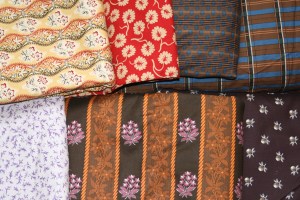
repro-fabricWhen looking at reproduction fabrics, remember you can always pick fabrics from an earlier time period than your doll, as people saved and re-worked the fabric from used garments. Doll clothing, like quilts, could easily have been made from someone’s stash of worn out clothing.

Locate a shop in your area that sells quilting fabrics and supplies. Give them a call to make sure that they have Civil War era fabrics, and then treat yourself to a field trip. Browse through the shop and enjoying imagining your dolls dressed in all of the interesting prints you will find.

If you prefer armchair shopping, I would like to suggest one of my favorite online sources for reproduction fabrics and one that you will find really easy to remember, www.reproductionfabrics.com . One of the best things about this site is that it is divided into time periods for you, which makes picking the right fabric a sure thing. Make sure to sign up for Margo’s newsletter. She shares very interesting textile tidbits and often has special sales for newsletter subscribers.
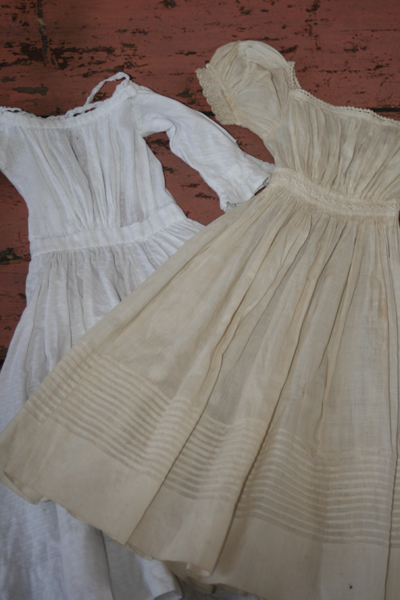
white-dresses-two1If you are looking for very fine white cottons, both plain and white on white, www.mini-magic.com is the place to go.


Some books on the subject that I find helpful are:

Dating Fabrics A Color Guide 1800-1960 by Eileen Jahnke Trestain

ISBN 0-89145-884-0

America’s Printed Fabrics 1770-1890 by Barbara Brackman

ISBN 1-57120-255-2


Two quilt books that have some great close-up photographs of antique fabric are:

American Folk Art Quilts by Maggi McCormick Gordon

ISBN 978-1-57076-400-4

American Quilts and Coverlets in The Metropolitan Museum of Art by Amelia Peck

ISBN 978-0-9797400-0-8
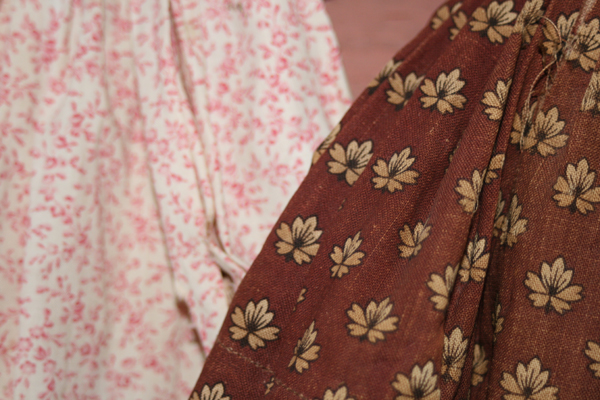
dress-fabric-close-up2

Antique Izannah Walker Dolls · Restoration and Conservation · Where to Shop

Laundry Day – Proper Washing Instructions for Antique Clothes

laundry1Today I am starting the first step in drafting patterns for my Izannah doll making class. Just like in any other type of pattern making, I have to first take accurate measurements before I can actually draw out the pattern. This means I need to start by undressing the doll.
Since I plan to measure both dolls and compare, then average their measurements, I’ll have to do everything twice. Being just like a child, and wanting to play with my new toy first, I’m starting with Izannah II. I really haven’t had the opportunity to actually sit down and spend a lot of time with her since she arrived here. Don’t think she’s been neglected; I’ve stared lovingly at her every time I pass by where she sits, so she doesn’t feel slighted.

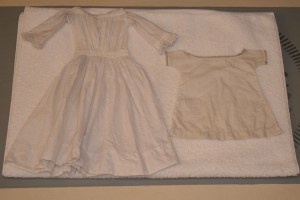
Izannah II has only two garments, a chemise and a dress.After carefully removing both pieces of clothing from the doll, I decided to wash them prior to measuring.

These are the steps I use to launder antique textiles:

  1. First, and most importantly, I carefully look over the item I want to wash to make sure that I think it is sturdy enough to survive cleaning.I make sure that it isn’t colored with dyes that will run and bleed when wet and that the fabric itself retains its integrity and is not disintegrating.As a general rule, don’t wash antique silks and examine wools to make sure they have been washed previously before you wash them.Cottons and linens usually wash well.
  2. I wash all antique fabrics with distilled water and Orvus, which is a museum-quality washing paste. If I am washing white or light-colored cottons or linens that are stained or discolored, I bleach them using sodium perborate.Sodium perborate is heat-activated, so it’s necessary to heat the distilled water before using. Never use sodium perborate on wool or silk!.
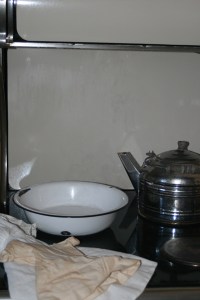
  3. laundry2If the item I’m washing is not too large, i.e. a piece of doll clothing, I usually wash it in an enamelware bowl. A plastic, glass, or other non-reactive bowl would also be fine to use. I place a small spoonful of Orvus in the bottom of the bowl, and then add several spoonfuls of sodium perborate, if I’m using bleach. Next I pour in the heated distilled water. The warmth of the water will dissolve the Orvus and make the sodium perborate start to work. If I want my wash water temperature to be a bit cooler, I add room temperature distilled water to the bowl, then stir and add the item I’m washing.
  4. Soak laundry in the bowl for about an hour, then rinse with distilled water at least three times or until the rinse water remains clear. Occasionally whatever I am washing will be so dirty that I will need to repeat these steps and wash it a second time.
  5. After rinsing, gently lift the antique textile and place it on a clean white towel to dry flat. Use only previously laundered towels, not new ones. Make sure that you lay the textile out to dry in an area out of direct sunlight and away from heat sources.
  6. Because heat is an enemy of antique fabrics, try to keep ironing to a minimum. By carefully smoothing garments as I lay them out to dry, I can usually avoid ironing altogether.

laundry-dryingWork day one is at an end, but I’ve gotten side tracked, and all I’ve managed to get done is the laundry! That has a very familiar ring to it. At least this laundry is a lot more fun than the run of the mill dirty t-shirts and jeans.

I generally buy my Orvus and sodium perborate from Mini-Magic. A friend of mine recently found sodium perborate for sale on eBay at a good price, so you might want to check there too. She also located some at The Chemistry Store.

Izannah Walker Project Ideas

Izannah-Inspired Spun Cotton Ornament

yellow-sc-izzypink-sc-izzy

If you are interested in this post, please visit my spun cotton ornament blog  for more information, photos and general chit chat about spun cotton ornaments.

This is an ornament that I’ve been thinking about making for some time. I’m sure you know how it goes, you are right in the middle of working on some other project, your hands busily doing some mindless, automatic pilot part of the process, your thoughts wandering all over the known universe. When, pop, suddenly you have a great idea!

This usually leads rather rapidly to the realization that you would really rather stop what you are working on so that you can immediately begin on your bright, shiny, new project. Then you give yourself a stern talking to, summon up all of your work ethic and guilt feelings, and continue on with what you were originally doing. Hopefully you remember your excellent idea and eventually get to make it a reality. Today is the day I decided to finally work on this particular bright, shiny bit of imagination.

I think the main forces that caused my thoughts to stray to this ornament were my plans for this Izannah doll making blog and a second blog that I have planned – to provide support for my spun cotton ornament classes. Thinking about project ideas for both blogs just led naturally to the idea for this project – one that combines both an Izannah Walker doll and a spun cotton ornament. I’ve worked in a couple of new embellishment ideas that I hope all of you spun cotton artists will find interesting.

Basic instructions and material lists for making spun cotton ornaments are provided in my regular in-person and by-mail classes. You are welcome to use the instructions below for your own personal use, but please do not use them for any commercial purposes. This means that you can’t sell items made with these instructions, patterns containing them, use them in teaching a class, or for any other money-making reason. You can however make as many as you want for yourself or to give away to your fortunate family and friends, if you can bear to part with your new ornaments.

  1. Cut a 9-½ inch long piece of wire for your body armature (which you will bend in half).Cut a 4-1/4 inch piece wire for the arms.Assemble the armature and proceed to make a standard spun cotton figure.I lightly sprayed mine with tea, as per the instructions given in class.
  2. Take a clear photograph of the face and shoulders of an Izannah Walker doll.Resize the image so that the face measures approximately 7/8 of an inch high. Print the re-sized image either in color or sepia on white card stock.Make sure you use the highest quality print setting available. Carefully cut out around the face and shoulder plate so that you have the equivalent of a lithographed paper scrap. Alternate ideas are to draw or paint your doll’s head, or to use the photograph of any young child, either old or new, that you would like. Sepia-toned prints may be hand-colored in the eyes, lips and checks.
  3. painting-sc-izzy2If you plan to hang your ornament, run a short length of floss, ribbon, or string through the top of the head. I used waxed twine. See class instructions for details.
  4. Mix brown acrylic paint with water in equal parts. My color choice was burnt umber. Paint the back of your figure’s head. Next paint on classic Izannah boots. Let dry.
  5. izzy-petticoatsCut white crepe paper 1-½ x 8 inches to form a petticoat. Glue in place.
  6. Cut colored crepe paper 1-¾ x 9 inches for skirt. Cut out bodice, sleeve and waistband pieces using the pattern given here, for the yellow dress, as a guide. Dress pieces for the pink dress mimic those in my Izannah Walker Doll Clothes Pattern. You may need to make adjustments to fit your figure as you go along.gluing-ribbons1painting-crepe-paper
  7. For trim like the yellow dress shown here, glue thin bands of 1/8 inch wide black ribbon along the lower edges of the skirt and sleeves. Let the glue dry completely before attaching the clothing to your Izannah ornament.
  8. If you prefer the all-over print like that in the pink dress, gather together three paint brushes with the same size handles, and rubber band them tightly together so that the ends of the handles form a triangle of dots. Dip the ends of the handles in undiluted acrylic paint, wipe the excess off on a paper towel, and then use the tips of the handle like a stamp to create an evenly-spaced pattern on the crepe paper for your dress. I suggest practicing first before you work on the actual dress pieces. Let the paint dry thoroughly before attaching the clothing to your Izannah ornament.
  9. Glue clothing to ornament per instructions given in class.
  10. If you would like, you may embellish the back of the dress bodice with tiny vintage buttons.
  11. Sign and date your ornament. Hang her somewhere that makes you smile.Enjoy!
  12. Visit my other blog www.spuncottonornaments.com for additional spun cotton ornament information.

If glue and paper aren’t your mediums of choice, I have listed two of these ornaments on eBay. They are also for sale on my website, Paula Walton’s A Sweet Remembrance.

izannah-spun-cotton-dress-p

Doll Clothing · Where to Shop

Brown Polished Cotton Lining Fabric

Very often in the mid 1800’s woman and children’s dresses were lined with a medium brown polished cotton fabric, also known as glazed cotton, and cotton sateen. It was a very sturdy, neutral, long wearing choice of lining material.

My Izannah Walker doll without curls wears her original dress, which has a bodice lining and false hem made of this fabric. The pattern for her dress is the one that I sell labeled Izannah Walker Doll Clothes Pattern for 18-1/2″ Doll.

I currently have one source for this lining fabric. It is available online from the Fashion Fabrics Club located in St. Louis, MO. They are selling this 54-inch wide fabric for $6.95 per yard. I have ordered from them several times and always been quite pleased with their fabrics and service.